What are the production planning tools?
Production planning tools are software systems that help manufacturers schedule, manage, and track the production process from raw materials to finished goods. They typically include batch scheduling, workload management, quality control checkpoints, inventory tracking, and real-time reporting. Modern platforms like Keel go further by allowing you to configure every stage around your specific process, terminology, and operational requirements.
What are the 5 steps of production planning?
The five core steps of production planning are: (1) forecasting demand to understand what needs to be produced; (2) capacity planning to assess available resources; (3) scheduling production batches and assigning tasks; (4) executing the plan with real-time monitoring of progress and quality; and (5) reviewing and adjusting based on actual output, exceptions and changing demand. Keel supports scheduling, batch management, QC checkpoints and review in a single configurable system, with demand-based suggestions for reordering materials.
How quickly can I get a custom production planning tool live?
With Keel's Build for Me service and managed migration support, most businesses are live with a fully custom production planning platform within a matter of weeks. Unlike traditional ERP implementations that take months or years, Keel's code-first approach and structured onboarding process are designed for speed without sacrificing configurability or quality.
Can Keel integrate with my existing tools and hardware?
Yes. Keel is designed to connect seamlessly with your existing tech stack, including ERP systems, e-commerce platforms like Shopify and Amazon, IoT devices such as smart shelves and sensors, financial systems, and third-party APIs. Integration is built in from the start, not added as an afterthought, ensuring your entire operation stays synchronised in real time.
Is Keel suitable for small to mid-sized manufacturers in Glasgow?
Absolutely. Keel is designed for businesses that have outgrown spreadsheets and no-code tools but cannot justify the cost or complexity of a traditional enterprise ERP. Whether you're a growing manufacturer in Glasgow, elsewhere in Scotland or across the UK, Keel delivers tailored production planning with the flexibility and speed modern businesses need, on one fixed yearly subscription billed in GBP.
Do I need a large development team to use Keel?
No. Keel's programmable platform is designed to let operators build and manage sophisticated custom software without a large internal development team. For those who prefer a fully managed approach, the Build for Me service has Keel's experts model and build the entire platform around your process, then hand over full ownership to your team at go-live.
How does Keel handle data security and compliance?
Keel takes data security seriously. Planko Ltd is registered with the UK's data protection authority, the Information Commissioner's Office (ICO), under reference ZB524558, and you can choose where your data is hosted, including the UK. The platform includes role- and row-based permissions, deny-by-default access control, full audit logs and OpenTelemetry observability, with a complete audit trail built for teams where compliance isn't optional.
What is the difference between Keel and a traditional ERP system?
Traditional ERP systems are rigid, expensive to implement, and slow to change—often forcing businesses to adapt their processes to fit the software. Keel is the modern ERP alternative: fully custom, code-first, and built around how your business actually operates. You own the platform, can iterate quickly, and are never locked into a vendor's roadmap or upgrade cycle.
What should production planning software for a Scottish manufacturer include?
At minimum: production orders and batches scheduled against customer orders and delivery dates, bills of materials and material requirements that drive purchase orders, capacity and lead times, QC checkpoints with specifications and tolerances, and traceability from raw materials to finished goods. Keel models your production stages, batches, QC checkpoints and traceability around your own terminology, connected to inventory and procurement in one system.
What is the difference between production planning and production control?
Production planning decides what to make, when and with which materials and people: scheduling batches against orders and capacity. Production control monitors execution: tracking progress, QC checkpoints, scrap and exceptions, then adjusting the plan. Good production planning and control software does both in one system, so the schedule reflects what is actually happening on the shop floor.
Does Keel have an office in Glasgow?
No. Keel is a UK company registered as Planko Ltd, headquartered in Altrincham, Cheshire, with a team in London. Our team can work with you remotely from Glasgow or anywhere else in Scotland, and the Build for Me service models your production process with your team and hands the finished platform over to you, so you are live in weeks without a local implementation partner.
Can production planning software replace spreadsheets or a legacy ERP?
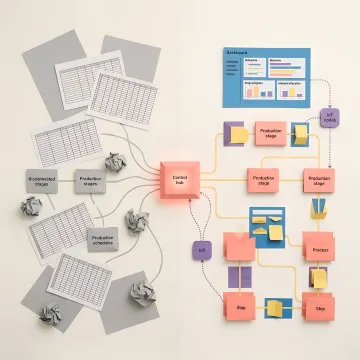
Yes. Many manufacturers plan production in spreadsheets alongside an ageing ERP, which leaves schedules out of date and materials ordered by email. Keel is the modern ERP alternative that bridges spreadsheets and legacy systems: it brings planning, inventory and purchasing into one tailored platform, with a managed migration from your existing tools and one fixed yearly subscription.
Is production planning software useful for Scottish food and drink manufacturers?
Yes. Food and drink producers need batch schedules tied to orders, ingredient lot tracking, expiry dates and quality checks. Food and drink manufacturers must be able to trace ingredients one step back and products one step forward so the Food Standards Agency or Food Standards Scotland can act quickly on a withdrawal or recall. Keel supports lot and batch tracking, expiry dates, quarantine statuses and QC checkpoints in the production flow, but you remain responsible for your own food safety compliance.
How is Keel priced for UK manufacturers?
Keel is priced as one fixed yearly subscription rather than per-user licences, and it costs a lot less than traditional ERPs, without doubling your budget for consultants. Payments are in GBP, with VAT added. Because every system is built around your process, contact the team for a price based on what you need.