
Introduction
For a UK retailer or brand selling through its own website, Amazon UK, eBay and trade accounts, every new channel adds orders that someone has to capture, check and route. As volumes grow, the gap between what manual processes can handle and what operations demand widens fast. Retyping orders between systems introduces errors, and every mistake that slips through costs time, reshipping and customer goodwill.
This is where the benefits of centralised order management show up. An order management system (OMS) pulls orders from every channel into one place, checks them against live stock and routes them for fulfilment. This article explains the key benefits of using an order management system in practice and the metrics they move, what goes wrong without one, and what UK businesses should check, from VAT on every invoice to UK carriers, marketplaces and data protection.
Key Takeaways
- An Order Management System centralises and automates the entire order lifecycle, from capture through fulfilment
- Reduces order error rates from 1–3% to near-zero through automation
- Provides real-time inventory visibility, preventing the $1.2 trillion global stockout problem
- New sales channels can go live in days, not weeks
- Businesses without a proper OMS spend more time fighting fires than scaling
- For UK businesses, a centralised OMS keeps VAT consistent across channels and invoices, which supports Making Tax Digital record-keeping
- Choose an OMS that works with the UK carriers, marketplaces and accounting software you already use
What Is an Order Management System?
An Order Management System is software that centralises and automates the process of receiving, processing, and fulfilling customer orders. It connects inventory, warehousing, shipping, and customer data into a single operational layer — so every order moves through your business without manual hand-offs or information gaps.
OMS is used across e-commerce, retail, healthcare, logistics, and any business that processes orders at scale. Gartner defines Distributed Order Management (DOM) — a core OMS capability — as software that orchestrates and optimises the order fulfilment process, drawing on inventory across the supply chain network to deliver targeted service levels and cost-effective, on-time fulfilment.
In practice, the value of an OMS shows up in order accuracy, fulfilment speed, and the operational visibility it gives teams — not in its feature list. The global order management software market reached $3.9 billion in 2023 and is projected to reach $6.2 billion by 2025, driven by demand for supply chain automation and digital transformation.
Key Benefits of an Order Management System
The benefits below focus on measurable, operational impact rather than theoretical gains. Each advantage ties directly to outcomes businesses track: cost, error rates, speed, and growth capacity. While individual features vary by platform, the advantages below represent what a well-implemented OMS consistently delivers across industries and business sizes.
Improved Order Accuracy and Processing Speed
How an OMS creates this advantage:
An OMS automatically ingests orders from all channels, validates them against inventory, and routes them for fulfilment without requiring human re-entry or cross-system copy-pasting at each step. Orders move from capture through picking, packing, and shipping with minimal manual intervention.
Why this is an advantage:
Manual order processing introduces compounding errors—wrong SKUs, duplicate orders, billing mismatches—that ripple downstream into returns, reshipments, and customer complaints. Customer service reps spend 20-40% of their time on manual order handling, which equates to one to two full workdays per week just entering data. The average error rate for manual order entry sits at 1-3%.
Removing manual touchpoints cuts this failure chain at the source. The costs add up fast:
- Data entry errors cost $50–$150 per incident, depending on how far the error travels before it's caught
- A single mispick costs $30–$75+, factoring in return processing, reshipment, and employee time
- For larger operations, annual losses at a single distribution centre can reach $400,000–$600,000
The customer trust impact compounds the financial damage: 73% of consumers who receive an incorrect item are less likely to do business with that organisation again.

Fewer errors means lower reverse logistics costs, fewer customer service escalations, and more reliable delivery promises. In a Forrester Total Economic Impact study, average order processing time was reduced from 8 minutes to 3 minutes per order, representing a 62.5% increase in order entry efficiency.
KPIs impacted:
- Order error rate
- Order cycle time
- On-time-in-full (OTIF) rate
- Return rate due to fulfilment error
- Customer service ticket volume
When this advantage matters most:
Accuracy and speed gains are most significant when order volumes are high, SKU counts are large, or the business operates across multiple sales channels where manual consolidation becomes unmanageable.
Real-Time Inventory and Multi-Channel Visibility
How an OMS creates this:
By integrating with inventory, warehouse, and sales channel systems, an OMS syncs stock data in real time so every order action—a sale on one channel, a return in another—is immediately reflected across the board. This eliminates the lag created by batch updates that leave businesses operating on stale data.
Why this is an advantage:
Without centralised visibility, businesses routinely oversell unavailable stock, miss reorder triggers, or fulfil from the wrong location. Global retail loses an estimated $1.77 trillion annually to inventory distortion, with out-of-stocks accounting for $1.2 trillion and overstocks totalling $562 billion.
The immediate financial impact of a stockout is a lost sale, but the downstream consequences go further:
- Stockouts drive an average 4% in lost sales; in 2021, CPG retailers lost 7.4% of sales to empty shelves
- When a product is unavailable, retailers lose nearly half of all intended purchases
- 43% of consumers will go to a competitor rather than wait for restock
Overselling occurs when businesses accept more orders than they have in stock, often due to poor inventory synchronisation across channels. 40% of sellers cancel at least 1 in 10 orders due to stock issues. In a documented case study, a specialty home goods retailer's overselling rate hit 8.3% during peak shopping periods. After implementing omnichannel inventory synchronisation, their overselling dropped from 8.3% to 0.4% of online orders.
Real-time visibility eliminates these costly blind spots. Accurate inventory data lets teams make fulfilment decisions confidently, reduces emergency reorders, and prevents the customer experience damage caused by failed delivery promises. A McKinsey survey found that 90% of consumers prioritise reliability over speed, and when deliveries are late, 60% of young shoppers will not buy from that retailer again.

KPIs impacted:
- Stockout rate
- Inventory accuracy
- Order fill rate
- Days of inventory outstanding
- Channel sync latency
When this advantage matters most:
This is especially critical for businesses selling across multiple channels (marketplace, DTC, wholesale), managing perishable or high-turnover inventory, or operating in regulated industries where stock accountability is mandatory.
Scalability and Operational Agility
How an OMS creates this:
By centralising order logic, automating rule-based decisions (routing, prioritisation, exceptions), and integrating with surrounding tools, an OMS lets operations teams absorb more complexity without proportionally increasing headcount or error risk. The system acts as an operational foundation that scales with the business.
Why this is an advantage:
Businesses relying on spreadsheets or stitched-together manual workflows hit an operational ceiling quickly. Peer-reviewed research indicates that 94% of operational spreadsheets contain undetected errors, making manual order management a massive operational risk as order volumes grow. When order volumes spike during peak periods or the business adds a new channel, the entire process can break. An OMS absorbs this variability by design.
During peak seasons like Q4 holiday shopping, order and shipment volumes see massive influxes that disrupt supply chain efficiencies. Without automated order routing, businesses struggle to maintain service levels. In contrast, brands utilising automated DOM routing can maintain "day zero" fulfilment—meaning if an order drops before noon, it ships that day—even during massive Q4 sales rushes.
A critical measure of operational agility is how quickly a business can onboard new sales channels or 3PL partners. Traditional order management software requiring custom integration development takes 4 to 6 weeks per client. Modern platforms with pre-configured connectors enable onboarding in days, preventing significant revenue delays.
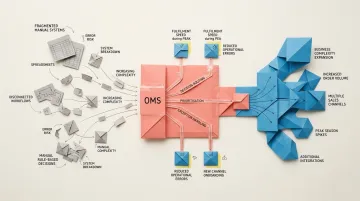
The ability to launch new fulfilment rules, add sales channels, or adjust workflows without months of development work is a direct competitive advantage for fast-moving operations teams. For businesses outgrowing spreadsheets but not ready for rigid enterprise ERP systems, purpose-built operations platforms like Keel extend this further by letting teams build and own custom OMS workflows that reflect exactly how their operations run, so the system adapts to the business rather than the other way around.
KPIs impacted:
- Order volume handled per headcount
- Time to onboard new sales channels
- Peak period fulfilment rate
- Workflow change lead time
When this advantage matters most:
This is most valuable during rapid growth phases, seasonal demand spikes, when entering new markets or channels, or in regulated industries where workflows must be customised to compliance requirements without sacrificing speed.
What Happens When OMS Is Missing or Ignored
Businesses that rely on spreadsheets, disconnected tools, or manual coordination for order management are working inefficiently and accumulating operational risk that compounds with scale.
Common consequences include:
- Handles the same order type differently across shifts or people, producing unpredictable fulfilment quality
- Surfaces errors only after the fact, when fixing them — reshipping, refunding, issuing credits — costs the most
- Creates overselling, phantom stock, and stockouts that damage customer trust and strain supplier relationships
- Ties order management knowledge to individuals, forcing proportional headcount increases as you grow
The financial burden is substantial. The average cost to process a single purchase order ranges from $50 to $150, with manual processes reaching as high as $506.52 per order. Legacy ERP systems and homegrown tools are often not designed to support complex order management and fulfilment processes across multiple channels, leading to siloed data sources, fragmented procedures, redundant inventory, increased shipping costs, and expensive backorders.
Add up the labour, returns, lost customers, and missed growth opportunities, and the total cost of operating without an OMS typically outweighs what a proper system would cost. UK retailers face the same inventory-distortion and fulfilment-error pressures; for UK-specific retail figures, see the British Retail Consortium and the Office for National Statistics. For teams outgrowing spreadsheets but not ready for a rigid enterprise ERP, purpose-built operations platforms like Keel offer a path to flexible, ownable order management infrastructure without the bloat.
How to Get the Most Value from Your OMS
Implementation gets you in the door. What determines actual value is how consistently the system is used, how well it connects to surrounding tools, and how readily it adapts as the business changes. Partial adoption or shallow integration will limit returns regardless of how capable the platform is.
Conditions under which OMS delivers compounding value:
- All channels feed into it — every order, regardless of source, flows through the OMS. Partial adoption recreates the siloed visibility problem the system is meant to solve.
- Teams review performance regularly — monitoring order accuracy, fulfilment rates, and exception patterns surfaces workflow improvements before they become costly.
- Workflows are updated as the business changes — when you add channels, expand SKUs, or enter new markets, routing rules and integrations should reflect that reality. A system that doesn't evolve with the business quickly becomes a constraint. With a custom-built platform like Keel's order management software, operations teams can change routing rules and workflows directly as channels, SKUs and markets change, without waiting for a vendor's development cycle.
Conclusion
An OMS earns its place not through any single feature, but through what it makes possible over time: fewer errors compounding into fewer lost customers, and better visibility compounding into smarter decisions. That cumulative effect is where the real value lives.
The advantages—reduced errors, real-time visibility, scalable fulfilment—grow more pronounced as the system becomes more integrated into daily operations. Treat it as operational infrastructure, not a one-time fix.
The businesses that get the most from their OMS, in the UK and elsewhere, tend to share a few habits:
- Use the system consistently across every channel and team
- Review outcomes regularly to catch inefficiencies early
- Allow the system to evolve as operational needs change
Frequently Asked Questions
What are the benefits of order management?
The core operational benefits include fewer errors through automated data validation, faster fulfilment with streamlined workflows, real-time inventory visibility across all locations and channels, centralised multi-channel management eliminating siloed systems, and better data for decision-making through comprehensive reporting and analytics.
What are the 4 stages of order management?
The four typical stages are: order capture (receiving orders from all sales channels), order processing and validation (checking inventory availability, verifying pricing, performing credit checks), fulfilment (picking, packing, and shipping the order), and post-fulfilment activities (tracking shipments, managing returns, and sending customer updates).
Is an OMS different than an ERP?
Yes. An OMS focuses specifically on the order lifecycle—from capture through fulfilment—with deep functionality for routing, inventory allocation, and channel management. An ERP is a broader system covering finance, HR, procurement, and operations across the whole business. Dedicated OMS tools offer greater depth for order-specific workflows than most ERP modules provide.
What size business needs an order management system?
Any business where manual errors, channel complexity or stock tracking have become recurring problems benefits from an OMS. For UK sellers, that point typically arrives at several hundred orders per month, or when you sell across several channels at once, such as your own website, Amazon UK, eBay and trade accounts, and need stock, VAT and fulfilment rules to stay consistent.
What is the difference between an OMS and a WMS?
An OMS manages the order lifecycle from capture to fulfilment, deciding where and how orders should be fulfilled across your entire network. A Warehouse Management System (WMS) focuses on the physical movement of goods within a specific warehouse—picking, packing, and shipping execution. They often integrate with each other but serve distinct operational functions.
How does an OMS improve customer experience?
An OMS enables accurate delivery promises, real-time order tracking, and proactive status updates. It also reduces fulfilment errors and makes returns easier to handle through structured workflows—directly improving customer trust and repeat purchase rates.
What are the benefits of centralised order management?
Centralised order management gives you one live view of orders and stock across every channel. That means fewer errors from retyping orders, no overselling between your website and marketplaces, consistent VAT and pricing rules, and faster routing to the right warehouse or carrier. It also puts customer data in one controlled place, which helps UK businesses meet their UK GDPR obligations.
How does an order management system help with VAT and Making Tax Digital?
An OMS applies the correct VAT treatment to each order and passes consistent invoice data to your accounting software, so VAT records stay digital and accurate. Making Tax Digital for VAT requires VAT-registered businesses to keep digital records and file returns through compatible software. The OMS itself doesn't file returns, but clean order and tax data makes the job in Xero, Sage or QuickBooks much easier.
Can an order management system work with UK carriers like Royal Mail, DPD and Evri?
Yes, most order management systems connect to UK carriers directly or through a shipping platform. Look for rules-based carrier selection, label printing, tracking updates sent back to the customer and end-of-day closeouts. Check which carriers each vendor supports before you buy. Keel's fulfilment tools cover carrier selection, label printing and tracking sync, configured around your own carrier accounts and rules.
When does a UK small business need an order management system?
Usually when you sell on more than one channel, such as your own website plus Amazon UK or eBay, or when order errors and stock mismatches become a weekly problem. Other signs are staff retyping orders between systems, overselling during peaks and VAT invoices that need manual fixing. Several hundred orders a month across channels is a common tipping point.
Where is order data stored, and what does UK GDPR require?
It depends on the vendor, so check where order and customer data is hosted before you sign. Customer names, addresses and order histories are personal data under UK GDPR, so your OMS provider acts as a data processor and needs a written contract with you. Keel is registered with the ICO (ZB524558) and lets you choose where data is hosted, including the UK.