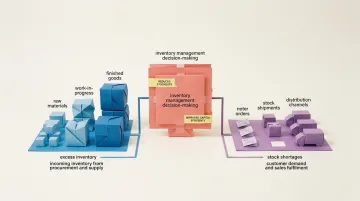
Inventory management means tracking and controlling the goods a business buys, holds and sells, from raw materials and work in progress to finished products, so the right stock is available at the right time. In the UK most businesses call it stock management or stock control, and for a UK manufacturer, wholesaler or online brand it decides how much cash sits on the shelves at the year-end stocktake.
At its core, it resolves a basic tension: holding too much stock ties up capital and increases holding costs, while holding too little risks stockouts, lost sales and damaged customer relationships. For UK businesses in food, drink, health and beauty or medicines, accurate stock records also underpin traceability and recall readiness.
This guide explains what inventory management means, how it differs from stock management, the main methods and system types, UK accounting and traceability points, and how to choose the right system.
Key Takeaways:
- Inventory management tracks goods from procurement to final sale, balancing capital efficiency with customer satisfaction
- Stockouts alone cost retailers nearly $1 trillion globally each year, eroding loyalty and revenue
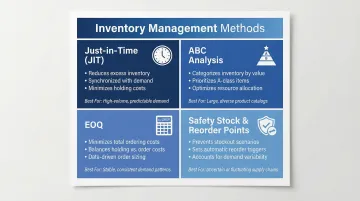
- Core methods include Just-in-Time (JIT), ABC analysis, Economic Order Quantity (EOQ), and safety stock/reorder points
- Modern systems leverage automation, real-time tracking, and API integrations to eliminate manual errors and improve decision-making
- Effective inventory practices directly impact profitability, cash flow, operational efficiency, and regulatory compliance
- In the UK, inventory management is usually called stock management or stock control; the methods are the same
- UK companies value stock under FRS 102 or IFRS, which permit FIFO and weighted average cost but not LIFO
Why Inventory Management Matters
Inventory management underpins three critical pillars of business performance: financial health, operational efficiency, and customer satisfaction. When executed well, it frees up working capital, reduces storage costs, shortens lead times, and ensures reliable stock availability. When executed poorly, the consequences compound quickly.
Stockouts cost retailers nearly $1 trillion globally each year, driving negative customer experiences that harm brand reputation and long-term loyalty. On the opposite end, overstocking steadily drains resources: typical holding costs—including storage, labour, insurance, taxes, shrinkage, and obsolescence—often comprise 20% to 30% of total inventory value annually.
The business case comes down to three areas:
- Lean inventory frees working capital, reduces write-offs, and cuts carrying costs
- Real-time visibility eliminates bottlenecks, reduces expedited shipping fees, and improves warehouse productivity
- Consistent product availability and accurate fulfilment drive retention and repeat purchasing
Beyond operations and finance, there's a compliance dimension that often goes overlooked. Under UK GAAP (FRS 102) and IFRS, companies must disclose the accounting policies used to measure inventories in their financial statements, and they need a reliable closing stock figure at the year end. Regulated industries face additional obligations: UK food businesses must be able to trace food one step back to their suppliers and one step forward to their business customers, as set out in Food Standards Agency guidance, and medicines supply chains must follow MHRA requirements. These aren't optional guidelines; they're legal obligations that make robust inventory systems essential.
The Inventory Management Process: Step by Step
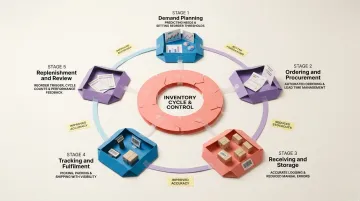
Effective inventory management follows a structured workflow that connects demand planning through replenishment. Each step builds on the last, creating a continuous cycle of visibility and control. For a detailed walkthrough with a step-by-step process flow, see our guide to the 5 stages of the inventory management process.
Demand Planning
Businesses analyse historical sales data, seasonal trends, and market signals to forecast future inventory needs. This planning sets reorder thresholds before stock runs critically low, balancing the risk of stockouts against the cost of excess inventory. Get this step wrong, and every downstream process pays for it.
Ordering and Procurement
Purchase orders are generated either manually by procurement teams or automatically by software, factoring in supplier lead times, minimum order quantities, storage capacity, and holding costs. Modern systems go further, integrating supplier catalogues, multi-currency pricing, and structured approval workflows to reduce friction and cut procurement cycle times.
Receiving and Storage
When shipments arrive, teams verify contents against purchase orders, conduct quality inspections, log items into the inventory system, and allocate goods to designated storage locations. Barcode scanners and RFID tags accelerate this process whilst reducing manual entry errors. Proper receiving workflows ensure system records match physical stock from day one.
Tracking and Fulfilment
Real-time tracking maintains continuous visibility of stock levels and item locations. Barcode scanners, RFID tags, and inventory software enable accurate order picking, packing, and shipping whilst automatically updating stock counts as orders are processed. Without robust tracking at this stage, phantom inventory creeps in: system records show stock that no longer physically exists, leading to failed fulfilment and customer complaints.
Replenishment and Review
Automated alerts trigger reorders when stock reaches predefined minimums, factoring in supplier lead times to prevent stockouts. Regular cycle counting, KPI reviews, and supplier performance assessments catch discrepancies and continuously optimise stock levels. Over time, these reviews sharpen forecast accuracy — the data flowing back into demand planning becomes more precise with every cycle.
Inventory Management Methods and Techniques
No single method fits every operation. The right approach depends on your product mix, demand patterns, and how much risk you can absorb in your supply chain — so most teams combine two or three of these techniques.
Just-in-Time (JIT)
JIT schedules orders and deliveries to arrive precisely when needed, making only what is needed, when it is needed, and in the amount needed. This reduces holding costs and waste significantly. However, JIT demands accurate forecasting and reliable suppliers. When supply chains face disruption—as many did during recent global events—JIT systems become vulnerable to stockouts and production delays.
That vulnerability makes it worth pairing JIT with a prioritisation framework — which is exactly what ABC analysis provides.
ABC Analysis
ABC analysis categorises inventory into three tiers by value, based on Pareto's law. A items represent 10% to 20% of total items but account for 50% to 70% of annual consumption value. B items comprise roughly 20% of items and 20% of value. C items make up 60% to 70% of items but only 10% to 30% of value. This stratification lets teams focus management attention, storage investment, and reordering resources on the highest-value inventory.
Economic Order Quantity (EOQ)
EOQ is a formula-based method that calculates the optimal batch size to order, balancing ordering costs against holding costs to minimise total inventory expense. The formula is Q = √(2DS / H), where D is demand, S is order cost per purchase, and H is holding cost per unit per year. EOQ assumes relatively steady demand, limiting its accuracy during periods of fluctuating sales.
Where EOQ tells you how much to order, valuation methods determine how you account for what you've already got.
FIFO and LIFO Valuation
First-In-First-Out (FIFO) assumes the oldest stock is sold first—standard for perishable or time-sensitive goods. Last-In-First-Out (LIFO) assumes the newest stock is sold first. Under IFRS (IAS 2), LIFO is strictly prohibited, and UK companies reporting under FRS 102 cannot use it either, so UK businesses choose between FIFO and weighted average cost. HMRC also does not normally accept LIFO for tax purposes. These methods produce different reported profits and tax liabilities, making valuation choice a strategic decision.
Safety Stock and Reorder Points
Safety stock is a deliberately maintained buffer inventory that protects against unexpected demand spikes or supply delays. Reorder points (ROP) are predefined stock levels at which a new order must be triggered to avoid running out before the next delivery arrives. Together, they give operations teams a defined trigger for action — reducing the guesswork that causes both stockouts and costly overbuying.
Key Benefits of Effective Inventory Management
When inventory management works well, the benefits cascade across the entire organisation. Each improvement feeds directly into cost, speed, and customer outcomes.
Cost Reduction
Accurate inventory data prevents overstocking that ties up working capital and creates write-offs. It also cuts carrying costs such as warehouse space, insurance, and labour associated with managing excess stock. Typical holding costs run 20% to 30% of total inventory value per year, making reduction a high-impact lever.
Improved Cash Flow
Lean, well-managed inventory keeps money moving through the business rather than sitting in unsold goods. Faster, more accurate fulfilment shortens the order-to-cash cycle, converting inventory into revenue more quickly. This liquidity enables reinvestment in growth rather than warehousing.
Stronger Customer Satisfaction
Consistent product availability, accurate order fulfilment, and reliable delivery times directly drive customer retention and repeat purchasing. Stockouts or errors erode brand trust quickly—especially in competitive markets where alternatives are one click away.
Greater Operational Efficiency
Real-time inventory visibility reduces time wasted locating stock, eliminates unnecessary inter-warehouse transfers, cuts expedited shipping fees, and enables warehouse teams to work more productively. When everyone knows exactly what's where, operations run more smoothly.
Data-Driven Decision Making
Operational efficiency is only sustainable if you can measure it. Inventory KPIs give operations teams the insight to make smarter purchasing, forecasting, and allocation decisions. Key metrics include:
- Inventory Turnover Ratio: Cost of goods sold divided by average inventory value, which measures how quickly inventory converts to sales
- Days Sales of Inventory (DSI): Average inventory value divided by COGS, multiplied by 365, indicating how many days stock sits before selling
- Fill Rate: Percentage of order items successfully fulfilled within a given period
- Stockout Rate: Frequency of inventory shortages leading to lost sales

Tracking these metrics consistently turns reactive firefighting into proactive planning — letting teams adjust before problems compound.
Common Inventory Management Challenges
Even with robust systems, inventory management presents persistent challenges. Knowing where things break down helps you build more resilient processes from the start.
Demand Volatility
Sudden shifts in demand caused by seasonality, economic changes, or viral trends make it difficult to maintain optimal stock levels. Common mitigation approaches include:
- Rolling forecasts that update weekly or monthly to reflect real conditions
- Safety stock buffers calibrated to your demand variability
- Flexible supplier agreements that allow rapid reordering without long lead times
Inaccurate Stock Data
Manual processes, data entry errors, theft, or unrecorded damage create discrepancies between system records and physical stock. An empirical analysis examining nearly 370,000 inventory records found that 65% were inaccurate. These discrepancies lead to phantom inventory, surprise stockouts, or overordering. Regular cycle counting is essential to maintaining data integrity and catching issues before they cascade.
Scaling Complexity
As businesses add SKUs, sales channels, or warehouse locations, inventory management becomes exponentially harder. Spreadsheets and basic tools that worked at an early stage often break down under this growth, creating operational blind spots. Nearly 25% of SMB software buyers rely on non-specialised tools, and 22% have no system in place at all — gaps that become increasingly costly as order volumes grow.
How to Choose the Right Inventory Management System
Selecting an inventory system is a strategic decision that shapes operational agility for years. The right choice depends on your current scale, growth trajectory, and operational complexity.
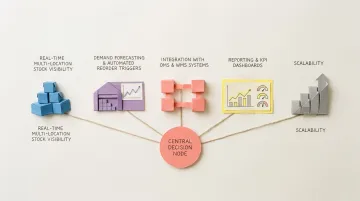
Core Capabilities to Evaluate
When assessing systems, prioritise these foundational features:
- Real-time multi-location stock visibility: Track inventory across warehouses, stores, and bins without delay
- Demand forecasting and automated reorder triggers: Eliminate manual monitoring and reduce stockout risk
- Integration with order management and warehouse systems: Ensure seamless data flow across your tech stack
- Reporting and KPI dashboards: Monitor turnover, fill rates, and stockout rates in real time
- Scalability: Handles volume growth and workflow changes without requiring re-implementation
System Type Trade-Offs
Manual spreadsheets work for very small operations but introduce errors at scale. Version control breaks down, data becomes fragmented, and real-time visibility disappears.
Off-the-shelf software offers speed of deployment and lower upfront cost but provides limited flexibility for unique workflows. As your business evolves, you'll face the choice of conforming your operations to the software or paying for costly customisation.
Custom-built or configurable platforms provide the most control and adaptability but have historically required significant development investment and long implementation timelines.
A Modern Alternative for Fast-Moving Teams
Fast-growing operations teams need systems they can own, iterate on, and tailor to how their business actually works. Keel is a modern operations platform that lets teams launch custom inventory management workflows in weeks, connect with existing tools, and scale on serverless infrastructure—without the constraints of legacy ERP systems.
Key capabilities include:
- Real-time stock visibility across every location, down to the bin level
- Automated reordering with supplier lead time factoring built in
- Barcode scanning for receiving and picking workflows
- Lot and batch tracking, serial numbers, expiry dates, and quarantine and hold statuses
- Inventory valuation using FIFO, average or standard cost
- Complete audit trails for compliance and traceability
The platform's code-first architecture gives teams total control whilst abstracting away infrastructure complexity — making it accessible to operations-adjacent engineers without requiring full-stack development expertise. Keel is built by Planko Ltd, a company registered in the United Kingdom and based in Altrincham, Cheshire, is registered with the ICO (ZB524558), and offers multi-region data residency, so you can choose where your stock data is hosted, including the UK.
Frequently Asked Questions
What is an inventory management system?
An inventory management system is software that automates the tracking, ordering, storage, and reporting of inventory in real time. It replaces manual and spreadsheet-based processes with accurate, always-current stock data accessible across your organisation.
What are the 4 types of inventory management?
The four types usually refer to categories of inventory rather than systems: raw materials (inputs for production), work in progress (items part-way through manufacture), finished goods (ready to sell) and MRO supplies (maintenance, repair and operations items). Each needs different tracking priorities and reorder logic. Types of inventory management system are different again, ranging from spreadsheets and periodic counts to perpetual barcode-based systems, warehouse management systems and ERP modules.
What are the 5 steps of inventory management?
The five core steps are demand planning, ordering and procurement, receiving and storage, tracking and fulfilment, and replenishment and review. These steps form a continuous cycle that maintains inventory accuracy and availability.
What are the 5 benefits of inventory management?
Key benefits include reduced carrying costs, improved cash flow, higher customer satisfaction, greater operational efficiency, and better data for strategic decision making. Businesses that manage inventory well consistently outperform those relying on reactive, manual processes.
What is the 80/20 rule in inventory?
The 80/20 rule (Pareto Principle) holds that roughly 80% of a business's revenue typically comes from 20% of its products. This principle forms the basis of ABC analysis, helping teams concentrate resources on the highest-value items whilst managing low-value stock with simpler controls.
What is an example of inventory management?
A UK food and drink producer is a good example of inventory management in practice. It sets reorder points so ingredients and packaging arrive before production runs, records batch numbers and use-by dates at goods-in, and picks stock first-expired-first-out. If a supplier recalls an ingredient, it can trace which batches of finished goods were affected and which customers received them, keeping availability high without holding excess stock.
What is the meaning of inventory management?
Inventory management means planning, tracking and controlling the stock a business holds so it has enough to meet demand without tying up unnecessary cash. It covers what to buy and when, how goods are received, stored and recorded, how orders are fulfilled, and how stock is counted and replenished. In the UK the same activity is often called stock management or stock control.
Is stock management the same as inventory management?
Yes, for most businesses stock management and inventory management mean the same thing. Stock management is the term more commonly used in the UK, while inventory management is more common in US content and software. Some accountants use inventory more broadly to include raw materials, work in progress and supplies, and UK financial statements use the formal term inventories, but the methods and systems are the same.
Can UK companies use LIFO to value stock?
No, UK companies generally cannot use LIFO to value stock. Both IFRS (IAS 2) and FRS 102 prohibit the last-in, first-out cost formula, so UK businesses use first-in, first-out (FIFO) or weighted average cost, with specific identification for items that are not interchangeable. HMRC also does not normally accept LIFO for tax. Confirm the method that suits your business with your accountant.
What is the difference between perpetual and periodic inventory systems?
A perpetual inventory system updates stock records in real time every time goods are received, picked, sold or adjusted, usually through barcode scanning. A periodic system only updates stock at set intervals, typically after a physical count or stocktake. Perpetual systems give an accurate live view for purchasing and sales, while periodic systems are simpler but leave you blind between counts, which becomes risky as ranges and order volumes grow.
What inventory management software do UK businesses use?
UK businesses use a wide range of inventory management software depending on size. Small firms often start with spreadsheets or the stock features in accounting software such as Xero, Sage or QuickBooks. Growing businesses move to dedicated inventory or warehouse management systems, and larger groups use ERP inventory modules. Businesses with unusual workflows, such as batch-controlled production or multi-channel stock, may build a tailored system on a platform like Keel.