
Introduction
It's late November in a small Midlands warehouse. A wholesale customer phones for 200 units of your best seller before Christmas, but the shelf is empty, while three aisles over £20,000 of slow-moving stock sits untouched, holding cash you need for your next VAT bill. That tension is what stock management is about. As the Federation of Small Businesses puts it, "Too much stock ties up your cash. Too little costs you sales."
For UK product businesses (manufacturers, wholesalers, retailers and online brands) stock management decides whether customers get what they ordered, whether working capital keeps moving, and whether your stock figures stand up when your accountant prepares the year-end accounts.
This guide explains what stock management means, how it differs from stock control, the stock control methods UK businesses use, how to run a stocktake, and how to choose a stock management system that fits the way you work.
Key Takeaways
- Stock management oversees every item from purchase through sale—raw materials, WIP, and finished goods
- Poor execution causes stockouts, excess inventory, tied-up capital, and customer dissatisfaction
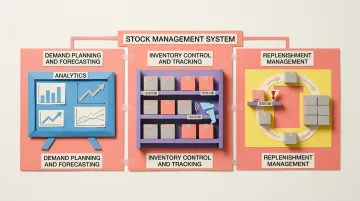
- Covers three core areas: demand planning, inventory control, and replenishment
- Best practices include FIFO, ABC analysis, reorder points, regular audits, and real-time visibility systems
- In the UK, "stock management", "stock control" and "inventory management" are used almost interchangeably; stock control is the day-to-day counting and record-keeping part
- Accurate stock records matter beyond the warehouse: your closing stock value feeds your year-end accounts, and VAT-registered businesses keep digital records under Making Tax Digital
What is Stock Management?
Stock management is the end-to-end process of overseeing a company's inventory across its entire lifecycle: from purchasing and receiving, through storage and movement, to final sale or use. Also called inventory management or stock control, these terms are used interchangeably across industries.
Process vs. System
Understanding the distinction between stock management as a process and as a system is crucial for operations teams deciding where to invest. The process covers the policies and workflows a business follows—demand forecasting, reorder triggers, audit schedules. The system refers to the tools or software used to execute those workflows—spreadsheets, off-the-shelf platforms, or custom-built infrastructure. Many articles blur this line, but clarity here helps teams diagnose whether their problem is procedural, technological, or both.
Operational Foundation
Stock management feeds into supply chain management, procurement, order fulfilment, and financial planning — it underpins every operational process in product-based businesses. The Chartered Institute of Procurement & Supply defines it as "the practices and processes used to control goods throughout the supply chain, from raw materials through to finished goods".
Complexity Varies
A small retailer sourcing finished goods has simpler needs than a manufacturer tracking raw materials, work-in-progress, and components across multiple locations. The principles remain constant, but the execution scales with operational complexity.
The 4 Types of Stock
Understanding your stock mix is the starting point for managing it effectively. Any stock management system needs to account for these four standard categories:
Raw Materials and Components
Raw materials are inputs used to produce goods—not yet transformed. For manufacturers, these need close tracking because shortages here halt production entirely. A packaging business running out of cardboard, for example, can't fulfil orders regardless of how many finished boxes sit in the warehouse.
Work in Progress (WIP)
WIP is stock that has entered production but isn't yet complete. It's often the hardest category to value and track because it represents partial transformation—materials consumed, labour applied, but no finished product yet.
For production planning, excessive WIP is a reliable signal of bottlenecks or inefficient workflows that need addressing.
Finished Goods
Finished goods are items ready for sale or dispatch. Most B2C businesses primarily manage this category, tracking stock levels, SKU variants, and fulfilment readiness. B2B and manufacturing businesses, however, manage finished goods alongside the other three categories simultaneously, which means stock decisions in one category directly affect the others.
Consumables (MRO)
Consumables—also called Maintenance, Repair, and Operations (MRO) supplies—are items consumed in day-to-day operations but not sold. Common examples include:
- Fuel and machinery lubricants
- Packaging materials
- Cleaning and safety supplies
They need regular replenishment but don't appear in finished goods inventory.
Core Principles of Stock Management
Operations teams need to master three areas that determine whether stock management works in practice: demand planning, inventory control, and replenishment management. Get these right and you avoid both stockouts and over-ordering. Get them wrong and you're firefighting constantly.
Demand Planning and Forecasting
Demand planning predicts how much of each SKU you'll need over a given period. Poor forecasting is the root cause of both excess inventory and stockouts — everything downstream depends on getting this right.
Key inputs include:
- Historical sales data and growth projections
- Seasonality patterns and planned promotions
- Market trends and external signals (weather, foot traffic, macroeconomic conditions)
Traditional demand planning forecast error averages 49% across global manufacturers, according to E2open's 2018 benchmark study. However, AI-driven forecasting reduces errors by 20–50%, cutting lost sales by up to 65% and warehousing costs by 5–10%. Modern forecasting must incorporate external data to predict demand accurately in volatile environments.
Inventory Control and Tracking
Accurate forecasting only works if the underlying stock data is reliable. Inventory control is the practice of knowing exactly what stock you have, where it is, and in what condition. Two main approaches exist:
Periodic Stock-Taking: Physical counts at set intervals (monthly, quarterly, annually). Suitable for smaller operations with low SKU counts, but labour-intensive and prone to gaps between counts.
Perpetual Inventory Management: Continuous real-time tracking via barcodes or RFID. Essential for higher-volume, multi-location, or high-SKU businesses where outdated data causes operational failures.
Every gap between what your records say and what is actually on the shelf turns into lost sales, excess stock or operational firefighting, so even perpetual records need checking against regular physical counts.
Replenishment Management
Once you know what you have, you need a system for deciding when to reorder and how much. Two calculations anchor this:
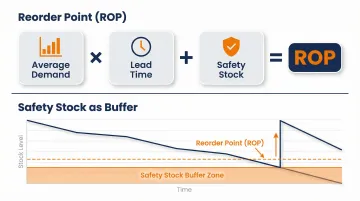
Reorder Point (ROP): The stock level that triggers a new order, calculated as (Average Demand × Lead Time) + Safety Stock.
Safety Stock: The buffer held above the reorder point to absorb demand variability or supplier delays. Accurate ROP and safety stock calculations give operations teams predictability — miscalculate either and you're either holding too much capital in stock or scrambling to cover shortfalls.
The Role of Supplier Relationships
Even precise internal calculations fail when supplier lead times are unreliable. A 1% decrease in mean lead time can save 0.3–0.4% in safety stock costs, while a 1% decrease in lead time variance saves 0.05–0.1%.
Tracking supplier performance feeds directly back into your ROP and safety stock figures. Key metrics to monitor include:
- On-time delivery rate
- Lead time variability (how much actual lead time deviates from quoted)
- Order fill accuracy
Treat supplier data as an input to your replenishment model, not just a vendor scorecard.
Stock Management Best Practices
Principles provide the framework. These are the practices high-performing operations teams actually use day-to-day — the specifics that keep stock management tight as volume and complexity grow.
Use the FIFO Method
FIFO (First In, First Out) means stock that arrives first should be sold or used first. This reduces the risk of expired, obsolete, or deteriorating inventory accumulating unnoticed. It applies beyond food and perishables — electronics, fashion, and hardware all benefit from preventing older models from sitting idle while newer versions arrive.
Financially, FIFO matters too. During inflationary periods, it results in lower cost of goods sold and higher reported profits.
Implement ABC Analysis
ABC classification ranks inventory by annual consumption value:
- A-items: 10–20% of SKUs, 70–80% of value—require tight controls and frequent review
- B-items: ~30% of items, 15–25% of value—moderate controls
- C-items: 50–55% of items, 5–10% of value—manage loosely

Applying the same management effort to every SKU wastes time. ABC analysis tells you where tighter controls actually pay off.
Set Reorder Points and Automate Alerts
Calculate a basic reorder point using average daily usage and supplier lead time, with safety stock added as a buffer. Manually monitoring this across dozens or hundreds of SKUs is unreliable — automated low-stock alerts remove the dependency on someone catching it before a stockout hits.
Conduct Regular Stock Audits and Cycle Counts
Distinguish between a full physical inventory count (time-intensive, typically annual) and cycle counting (rotating, ongoing partial counts throughout the year). Cycle counting is best practice for active operations because it catches discrepancies faster without shutting down operations.
Correcting inventory records via audits led to an 11% increase in store-wide sales, concentrated on items with negative discrepancies (hidden stockouts). Shrinkage (losses from damage, theft and admin errors) affects UK retailers, wholesalers and manufacturers alike, and regular audits are how you measure it and bring it down.
Classify and Review Slow-Moving Stock
Ignoring low-turnover stock costs money: it occupies warehouse space, ties up capital, and often deteriorates in value. Set a review trigger (e.g., no movement in 6–12 months), then act — through discounting, bundling, returning to supplier, or writing off. Distinguish between slow-moving stock (still saleable, just not moving quickly) and obsolete stock (unsaleable), as each requires a different response.
Choosing the Right Stock Management System
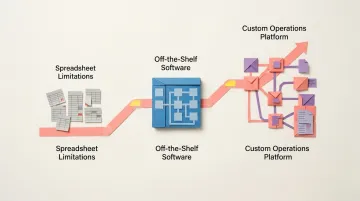
Most businesses move through three stages: spreadsheets (workable early on, but they break at scale), off-the-shelf inventory software (faster, but often too rigid for non-standard workflows), and a custom operations platform built around how the business actually works.
Spreadsheet Limitations
94% of business spreadsheets contain critical errors. In mid-market operations, planners spend 40–60% of their time on manual spreadsheet maintenance, leading to stock discrepancies of 15–25%. Spreadsheets lack real-time updates, are error-prone, and disconnect from other systems, making them unsuitable beyond the earliest stages.
Off-the-Shelf Software
Off-the-shelf platforms, including the stock control features built into UK accounting software such as Xero and Sage, offer speed but impose rigid workflows. 25% of SMB buyers currently rely on non-specialised tools like accounting platforms, and 22% have no system at all. Buyers seek dedicated systems due to limited functionality and lack of user-friendliness in manual methods.
Custom Operations Platforms
The right system depends on operational complexity. A business managing four SKUs from one location has very different needs than one managing hundreds of SKUs across multiple warehouses with custom replenishment rules. Most teams outgrow each stage faster than they expect — the trigger is usually a stockout or reconciliation failure that a spreadsheet or rigid platform simply can't prevent.
What to Look For:
- Real-time inventory visibility across all locations
- Seamless integration with existing tools (ERP, WMS, order management, supplier systems)
- Customisable data models that reflect your actual stock structure
- Role-based access and audit trails
- Scalability without platform constraints
Keel is built for teams at exactly this inflection point — operations that need the flexibility of custom software without the months of development work. Teams typically go from requirements to a working system in weeks, with full ownership of their data and workflows from day one.
Frequently Asked Questions
What is the best way to manage stock?
The best way to manage stock is to combine clear processes (demand forecasting, reorder points, safety stock and regular stocktakes) with a system that matches your scale. A UK small business with a short product range may manage well with min/max levels in a spreadsheet; a manufacturer or multi-location brand needs real-time records, batch tracking and cycle counts. Neither strong processes nor powerful software deliver results without the other.
What does stock management do?
Stock management ensures a business always has the right products in the right quantities at the right time, while minimising the cost of holding excess inventory and preventing costly stockouts. It balances capital efficiency with operational reliability.
What are the three areas of stock management?
The three core areas are demand planning (predicting what you'll need), inventory control (knowing what you have and where), and replenishment management (deciding when and how much to reorder). How well these three areas work together directly shapes your stock availability, carrying costs, and overall operational resilience.
What are the 4 types of inventory?
The four types of inventory, usually called stock in the UK, are raw materials (unprocessed inputs), work in progress (partly finished goods), finished goods (items ready for sale) and consumables (supplies used in day-to-day operations but not sold, such as packaging). Each needs a different approach to tracking and valuation, which matters when you prepare year-end accounts.
What is the difference between stock management and stock control?
Stock management is the broader discipline: planning demand, deciding what and when to buy, storing stock and reviewing performance. Stock control is the narrower, day-to-day part: keeping accurate records, counting what you hold and triggering reorders. In the UK the terms are often used interchangeably, and "inventory management" usually means the same thing. Most small businesses need both: a clear process and a reliable way to track stock.
What does stock management mean for a small business?
For a small business, stock management means holding enough of each product to meet orders without tying up cash you need elsewhere. In practice that is setting reorder levels, counting stock regularly, rotating older or date-marked stock first and reviewing slow sellers. For many UK small businesses stock is one of the biggest uses of cash, so better stock management usually improves cash flow before anything else.
Can I use Excel for stock management?
Yes, Excel or Google Sheets can work for a small range sold from one location, particularly with simple min/max or reorder point formulas. Spreadsheets struggle once you have hundreds of SKUs, several locations, batch or expiry tracking, or several people updating stock at once, because they do not update in real time and errors creep in. That is usually the point to move to stock management software.
How often should a UK business do a stocktake?
Many UK businesses do a full stocktake at least once a year, at or near their financial year-end, so the closing stock figure in the accounts is accurate. Many also count before busy periods such as Christmas. Businesses with large ranges or high-value stock often add cycle counts, checking a few locations or top-value items every week, so problems surface long before the annual count.
What is a stock management system?
A stock management system is the software, or set of tools, a business uses to record stock coming in and going out, show current stock levels by location, trigger reorders and support stocktakes. Options range from spreadsheets and stock features inside UK accounting tools such as Xero or Sage, to dedicated inventory software, to custom operations platforms built around a business's own products, locations and workflows.
How should stock be valued in UK accounts?
UK accounts generally value stock at the lower of cost and net realisable value, using a consistent method such as FIFO or average cost. Cost includes the purchase price and the costs of getting stock into its current location and condition. Because closing stock affects reported profit and tax, it is worth agreeing the method with your accountant and checking current guidance on GOV.UK.