Introduction
Picture a fabrication business in the West Midlands: a customer asks for 40 stainless enclosures to their drawings, due in five weeks. The quote is built in a spreadsheet, the job is tracked on a whiteboard, and nobody knows the true margin until the invoice has gone out through Sage or Xero. That is the gap make-to-order software is meant to close.
Most ERP systems are built for the opposite of UK job shops: predictable production for stock, or large engineered projects. If you build to customer specifications, whether from configurable designs (make-to-order) or with engineering work on every job (engineer-to-order), you need software that links quotes, bills of materials, job costs and delivery dates in one place.
This guide compares the leading make-to-order and engineer-to-order ERP options for 2026, explains what UK manufacturers should check before buying (VAT, Making Tax Digital, CIS and UK support), and shows how to match a system to your size and complexity.
Key Takeaways
- MTO manufacturers need ERPs with flexible BOMs, job costing, and customer order-driven production workflows
- Top MTO and ETO ERPs in 2026: Acumatica, Epicor Kinetic, Genius ERP, NetSuite, and Keel (the code-first alternative)
- Evaluate on MTO-specific features, implementation speed, scalability, and total cost of ownership
- Legacy ERPs are routinely over-engineered and slow to deploy for SME manufacturers
- Company size, production complexity, and IT capacity all determine which platform actually fits
- UK buyers should also check how a system posts invoices and job costs to Xero, Sage 50 or QuickBooks, handles VAT on deposits and keeps VAT Returns compatible with Making Tax Digital
- Engineer-to-order shops need more than MTO: design-to-quote, changing multi-level BOMs, project job costing and concurrent job scheduling
What Is Make-to-Order Manufacturing (and Why Does ERP Selection Matter)?
Make-to-order (MTO) manufacturing means you only build products once a customer order is placed. Production planning, materials procurement, and scheduling are all triggered by actual demand rather than forecasts. This customer-driven approach eliminates speculative production and finished-goods inventory, but introduces longer lead times and greater operational complexity.
How MTO Differs from Other Manufacturing Modes
MTO sits between two other common manufacturing strategies:
- Make-to-Stock (MTS): Mass-produces goods for inventory based on demand forecasting. Offers immediate delivery but carries high inventory holding costs and obsolescence risks.
- Engineer-to-Order (ETO): Requires custom engineering and design work before production can begin. Involves the longest lead times and highest complexity, with unique BOMs for each project.
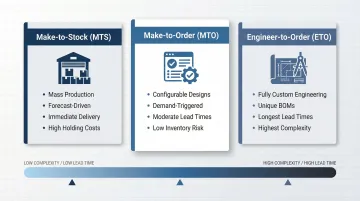
MTO uses repeatable product configurations with limited customisations—you have existing designs, but each order may have customer-defined variations that affect materials, routing, or specifications.
Why Standard ERPs Fail MTO Businesses
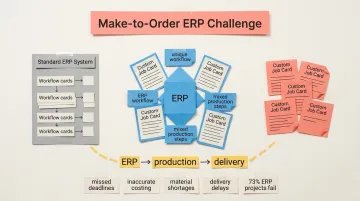
Generic ERP systems are poorly suited to MTO workflows. They're typically optimised for either high-volume stock production (MTS) or complex project-based engineering (ETO), leaving mid-market MTO manufacturers stuck between spreadsheets and over-engineered legacy systems.
The operational fallout is familiar:
- Job status lives on spreadsheets, whiteboards and paper travellers rather than in one system
- Quotes are built by hand, so they go out slowly and margins on custom jobs are estimated rather than known
- Job costs are only reconciled after the invoice has gone out, when it is too late to reprice the work
Best ERP Software for Make-to-Order Manufacturing in 2026
These tools were evaluated on MTO-specific functionality, ease of implementation, scalability, integration capability, and fit for SME and mid-market manufacturers. They're not ranked — each suits a different buyer profile, so use the breakdowns below to find the right match for your operation.
Acumatica
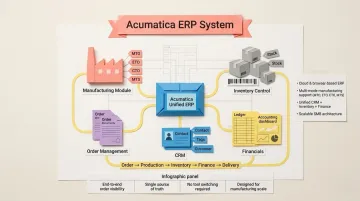
Acumatica is a cloud and browser-based ERP for SMBs that explicitly supports multiple manufacturing modes including MTO, ETO, configure-to-order (CTO), and make-to-stock within a single platform. With a global partner network and consumption-based pricing, it's designed to scale without per-user penalties.
The unified platform connects manufacturing management, CRM, inventory, order management, and financials in one system — giving MTO manufacturers end-to-end order visibility without switching between tools. That single-source-of-truth approach is what sets it apart from point solutions.
| Attribute | Details |
|---|---|
| Key MTO Features | Multi-mode production support (MTO, ETO, CTO, MTS), production scheduling, BOM management, order management, CRM, inventory control |
| Deployment | Cloud or on-premises |
| Pricing | Contact Acumatica for pricing (APEX bundle includes software, implementation, and support) |
Acumatica was named a Leader in the 2024 IDC MarketScape for worldwide SaaS and cloud-enabled small business ERP applications and the 2025 Nucleus Research SMB ERP Technology Value Matrix.
Epicor Kinetic
Epicor Kinetic is a manufacturing-first ERP with nearly 50 years in the market, serving global manufacturers in discrete and mixed-mode environments including MTO. It's particularly strong in mid-market and enterprise manufacturing contexts where real-time production tracking and technical data management are critical.
For MTO businesses running mixed workflows — some custom orders, some repeat configurations — automation and visibility are where Epicor earns its place. Real-time job progress tracking and advanced engineering change management help teams stay on top of production without manual status chasing.
| Attribute | Details |
|---|---|
| Key MTO Features | Real-time job progress tracking, advanced MRP, engineering change management, production scheduling, analytics and reporting |
| Deployment | Cloud or on-premises |
| Pricing | Custom-quoted per-user subscription (contact Epicor for pricing) |
Epicor was named a Leader in the 2025 Gartner Magic Quadrant for Cloud ERP for Product-Centric Enterprises for the third consecutive year.
Genius ERP
Genius ERP is an end-to-end manufacturing ERP built specifically for high-variability SME production. It explicitly supports MTO, ETO, custom-to-order, and assemble-to-order workflows with strong CAD-to-BOM integration.
Smaller MTO manufacturers that need purpose-built functionality without enterprise complexity will find it a natural fit. Automated quoting, centralised department connectivity, and shop-floor bottleneck reduction are all baked in — not bolt-ons.
| Attribute | Details |
|---|---|
| Key MTO Features | Automated quoting, BOM management, work orders, job costing, shop-floor scheduling, MRP, customer order management |
| Deployment | Cloud |
| Pricing | Quote-based via DIY pricing calculator (contact Genius ERP for details) |
Genius ERP is TEC Certified for ETO Manufacturing and earned a spot on the 2024 Capterra Shortlist for manufacturing execution software.
NetSuite (Oracle)
Oracle NetSuite is a globally used cloud ERP supporting manufacturers in over 20 industries, with strong financial management, supply chain planning, and multi-currency/multi-language capabilities suited for growing MTO businesses.
The platform serves over 43,000 customers across 220 countries and territories, making it the strongest option for MTO manufacturers scaling internationally or needing tight financial-operational integration. Teams under 20 people or those without multi-entity requirements may find it more than they need.
| Attribute | Details |
|---|---|
| Key MTO Features | Supply chain planning, advanced financials, demand management, inventory management, work orders, multi-entity and multi-currency support |
| Deployment | Cloud |
| Pricing | Custom-quoted annual subscription (core platform + modules + users) |
NetSuite was named a Leader in the 2025 Gartner Magic Quadrant for Cloud ERP for Product-Centric Enterprises.
Keel
Keel is a modern operations platform built for fast-moving teams that have outgrown spreadsheets but don't want the rigidity of legacy ERP. Built by the former CEO, CTO, and CPO of Echo (Europe's fastest-growing online pharmacy, later acquired by Pharmacy2U), Keel is designed to give operations teams flexible, custom-fit tooling they actually own.
What makes Keel stand out for MTO operations: its code-first schema approach means production workflows, order management, and fulfilment logic can be tailored to a manufacturer's exact process—not forced into pre-built templates. Systems launch in weeks rather than months, with built-in auth, audit trails, and serverless infrastructure.
| Attribute | Details |
|---|---|
| Key MTO Features | Custom data models, production batches matched to orders and delivery, QC checkpoints, traceability from raw materials to finished goods, order management with customer pricing, credit terms and taxes, instant internal tooling generation, integrations with existing tech stack, built-in audit trails and permissions |
| Deployment | Cloud (serverless infrastructure) |
| Pricing | One fixed yearly subscription, billed in GBP with VAT added; contact Keel at hello@keel.so for prices |
Key Features to Look for in an MTO ERP
MTO ERP selection should start with production-specific capabilities you simply cannot compromise on:
Core Production Features
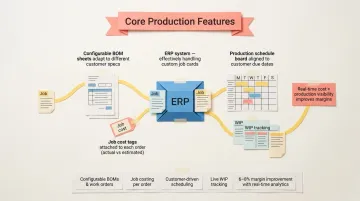
- Configurable BOMs and work orders that adapt to customer specifications
- Job costing (not just inventory cost) to track actual vs. estimated costs per order
- Production scheduling tied to customer due dates, not generic capacity planning
- Real-time work-in-progress tracking across concurrent custom orders
According to industry research, manufacturers utilising real-time cost analytics improve profit margins by 6–8% through reduced waste and improved efficiency.
Order and Quoting Management
Slow or inaccurate quotes cost MTO manufacturers real business. Your ERP should support:
- Configurable product options that reflect actual manufacturing capabilities
- Material cost estimation linked to current supplier pricing
- Seamless conversion from quote to work order without re-keying data
Manual quoting is expensive: slow quotes lose work to faster competitors, and quotes built from out-of-date material prices lose margin on the jobs you do win.
Integration and Flexibility
MTO manufacturers typically run niche tooling for CAD, CRM, or e-commerce alongside their core systems. The right ERP connects to these without requiring a full stack overhaul. Look for:
- Pre-built connectors or open APIs for common manufacturing tools
- Fast implementation timelines (weeks, not quarters)
- Configurable workflows that evolve as your processes change
Many MTO SMEs cannot absorb a 6–18 month deployment — the opportunity cost alone is enough to delay ROI before the system is even live.
How We Chose the Best MTO ERP Software
We assessed tools based on four core capabilities: support for demand-triggered production (not forecast-based), handling of variable BOMs and job costing, scalability for SME to mid-market manufacturers, and integration with existing operational tools.
Common Mistakes Buyers Make:
- Choosing an ERP based on brand recognition alone rather than MTO-specific fit
- Underestimating implementation effort and timeline
- Not evaluating operator-facing usability (which determines whether the system delivers value at all)
Evaluation Factors Tied to Business Outcomes:
| Feature | Business Impact |
|---|---|
| BOM Flexibility | Reduces rework and engineering errors by adapting to customer specifications |
| Accurate Job Costing | Protects margin on custom orders through real-time cost tracking |
| Implementation Speed | Determines how quickly ROI is realised and operations improve |
| Operator Usability | Drives adoption, which determines whether the system delivers value at all |
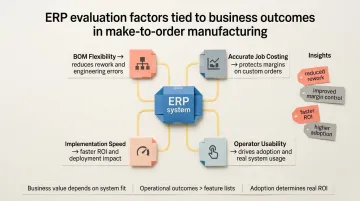
These factors matter because the cost of getting it wrong comes straight off the margin of each custom job, through scrap, rework and late deliveries.
Conclusion
The best ERP for MTO manufacturing is the one that maps to how your business actually runs—not the one with the most features or the biggest brand name. MTO manufacturers need demand-triggered workflows, accurate job costing, and systems their teams will actually use.
Before committing to any platform, evaluate shortlisted options against:
- Production complexity and how deeply the system supports your specific order types
- Team size and whether the interface your operators will use daily is genuinely intuitive
- Integration requirements with your existing quoting, scheduling, or finance tools
- Implementation timelines and what "go-live" actually means for your team
One thing not to compromise on: configurable BOMs and live job costing. Without both, you cannot accurately quote jobs or protect your margins under real production conditions.
For MTO teams that need a system live in weeks rather than months, Keel's code-first platform lets you build operations tooling you fully own and can evolve as your workflows change. Keel is run by Planko Ltd, a company registered in the United Kingdom; reach out at hello@keel.so to discuss how it fits your manufacturing setup.
Frequently Asked Questions
What is the best manufacturing software?
There is no single best manufacturing software; the right choice depends on your manufacturing mode (MTS, CTO, MTO or ETO), size and workflow complexity. For UK make-to-order and engineer-to-order manufacturers, Acumatica, Epicor Kinetic and Genius ERP are strong general options, UK-focused tools such as Flowlens target ETO firms, and Keel offers a flexible alternative for teams needing custom workflows.
Is SAP an ERP or MES?
SAP S/4HANA is primarily an ERP platform covering finance, supply chain, and manufacturing planning. SAP also offers separate MES capabilities through SAP Digital Manufacturing Cloud, which integrates with the core ERP for shop-floor execution.
What is the difference between make-to-order and engineer-to-order manufacturing?
MTO produces products using existing designs with limited customer-defined variations and shorter lead times. ETO involves custom engineering work per order, with unique BOMs for each project and significantly longer lead times due to the design phase before production can begin.
What features should MTO ERP software include?
Core must-haves include configurable BOMs, work order management, job costing (tracking actual vs. estimated costs), production scheduling linked to order due dates, MRP functionality, and customer order management that converts quotes to work orders seamlessly.
How long does it take to implement an ERP for a manufacturing business?
Traditional enterprise ERPs typically take 6–18 months to implement, with a median project timeline of 15.5 months across all industries. Modern cloud-based platforms can go live in weeks, though the actual timeline depends on data complexity, integration requirements, and vendor support quality.
Can small manufacturers use ERP software, or is it only for large businesses?
ERP software is well within reach for small and mid-sized UK manufacturers. Modern cloud-based and modular options offer lower upfront costs and faster setup than traditional enterprise systems. When comparing, ask for GBP pricing ex-VAT, check how the system connects to Xero, Sage or QuickBooks, and confirm UK implementation and support are available.
What is the best ERP for a UK engineer-to-order job shop?
The best ERP for a UK engineer-to-order job shop is one that turns drawings into costed BOMs quickly, tracks job costs against each quote, schedules many one-off jobs at once and passes invoices cleanly to your UK accounts package. Acumatica and Genius ERP both state ETO support; UK-focused tools such as Flowlens target engineer-to-order firms; and platforms like Keel suit shops whose process fits no template.
What is the difference between engineer-to-order and configure-to-order?
Engineer-to-order means each order needs new design or engineering work before production, so the BOM is unique to the job. Configure-to-order means the customer chooses from pre-engineered options, and rules generate the BOM automatically with no new design work. CTO needs a good product configurator; ETO needs design-to-quote, engineering change control and project-based job costing.
Can make-to-order software link to Xero or Sage for VAT?
Many make-to-order systems can pass invoices and costs to UK accounting software, but check each vendor rather than assuming. Some UK-focused tools state it directly: Flowlens, for example, says it links with Xero, Sage 50 or QuickBooks. Ask how VAT on deposits and stage payments is recorded and how the data reaches your Making Tax Digital-compatible VAT Return.
What is engineering order management software?
Engineering order management software tracks an engineered or custom order from enquiry and quotation through design, bill of materials, purchasing, production and delivery. It sits between CRM and accounting, giving engineers, buyers and the shop floor one view of each job. For UK engineer-to-order firms it is often part of an ETO ERP or a dedicated job management system.
Does manufacturing software need to handle the Construction Industry Scheme?
Only if your work falls under it. The Construction Industry Scheme (CIS) can apply to UK manufacturers that install products on construction projects or pay subcontractors for construction work. If that is you, check that your system records subcontractor payments clearly enough for your accountant to prepare CIS returns, and confirm your obligations on GOV.UK.
How much does make-to-order ERP software cost in the UK?
Most make-to-order ERP vendors quote prices individually, based on users, modules and implementation effort, so ask for a GBP quote that separates subscription, implementation and support, and shows VAT. Acumatica, Epicor, Genius ERP and NetSuite all price on request. Keel charges one fixed yearly subscription, billed in GBP with VAT added, and costs a lot less than traditional ERPs.