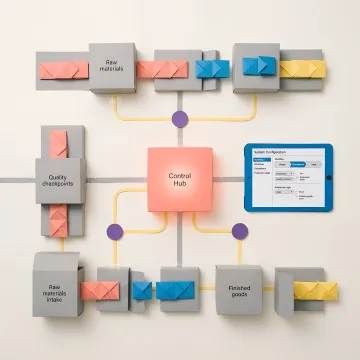
What is PMS in production?
A Production Management System (PMS) is software designed to plan, track, and control manufacturing operations from raw materials through to finished goods. It manages production batches, scheduling, quality control checkpoints, resource allocation, and traceability. A well-implemented PMS connects your production workflow to orders, inventory, and delivery—giving operators complete visibility and control over how things are made.
A PMS is often a module within a broader ERP, but it doesn't have to be. Keel's approach positions production management as a purpose-built, custom system—more flexible and operator-owned than a traditional ERP. You get the production control of an enterprise system without the rigid templates, multi-year implementations, or vendor lock-in that legacy ERPs typically impose on fast-moving businesses.
How long does a Production Management System implementation take?
With Keel, most production management system implementations go live within weeks, not months. The exact timeline depends on the complexity of your production workflow, number of integration points, and how many QC checkpoints and custom rules need to be modelled. Because we build directly to your process, there's no time wasted configuring a system that wasn't designed for you.
Can the system be built around our specific production stages and terminology?
Absolutely—this is a core principle of how Keel builds. We model your exact production stages, checkpoints, terminology, and exception rules. Nothing is mapped to generic manufacturing assumptions. Whether you call them 'batches,' 'runs,' or 'jobs,' the system reflects how your team actually operates, making adoption faster and eliminating costly workarounds.
Does the PMS integrate with our existing tools and inventory system?
Yes. Keel's platform is designed for seamless integration with your existing tech stack, hardware, and third-party tools. This includes inventory management, procurement systems, order management, warehouse workflows, IoT devices, e-commerce platforms, and financial systems—ensuring data flows automatically across your entire operation without manual reconciliation.
Who owns the system and data after implementation?
You do—completely. Unlike traditional SaaS or ERP vendors where your data and workflows are locked into their system, Keel builds you a system you fully own. You control the data model, the workflows, and the infrastructure. Your team can iterate and extend the system independently, without dependency on Keel for every change.
Does the system include quality control features?
Yes. Quality control checkpoints are built directly into your production flow during implementation—not bolted on as an afterthought. You define the specifications, tolerances, and approval gates, and we place them exactly where they need to be in the workflow. Every QC result is logged with a complete audit trail, which is especially important for regulated industries.
What happens after the system goes live?
Keel provides a full handover to your team, ensuring complete ownership and the ability to operate, iterate, and extend the system independently. Your team gains access to auto-generated internal tools for day-to-day operations. If you need ongoing support or want to build additional modules—like procurement or warehouse management—Keel can continue as your implementation partner.
Is Keel's production management system priced in GBP?
Yes. Keel is a UK-registered company and quotes UK manufacturers in GBP under a single fixed yearly subscription, with VAT added where applicable—contact the team for a quote based on your production operation.
Can we choose to host our production data in the UK?
Yes. Keel runs on multi-region infrastructure, so you choose where your environment is hosted, including in the UK, alongside Keel's own UK registration (Planko Ltd) and ICO registration (ZB524558).
Does the PMS handle VAT and Making Tax Digital record-keeping for production costs?
Keel's order and procurement modules factor in taxes such as VAT as part of pricing and supplier costs, and because you own the data model, records can be structured to support the digital record-keeping Making Tax Digital for VAT requires. Confirm your specific MTD obligations with your accountant or HMRC guidance.