
Introduction
For a UK distributor or manufacturer, the inventory management process is the system that controls how stock moves from purchase order and goods-in through storage and despatch to replenishment. When lead times swing, every weakness in that process shows up as stockouts or cash tied up on the shelf. Unleashed reports that in Q2 2025, UK manufacturers saw lead time nearly double in a single quarter, prompting many to hold more stock.
For operations managers, e-commerce teams and supply chain professionals, understanding each stage operationally, not just in theory, is what protects cash flow, customer satisfaction and margins. Failures rarely start in the warehouse; they come from weak forecasting, poor tracking and disconnected workflow stages.
This guide breaks down the 5 stages, shows the inventory process flow step by step, and covers the UK-specific points (imports, stocktakes, valuation and traceability) that generic guides skip.
Key Takeaways
- Five stages make up the inventory management process: demand forecasting, purchasing, storage, order fulfilment, and tracking
- Each stage directly feeds the next, so a weakness in one breaks the entire cycle
- Treat it as a continuous loop, not a one-time setup — it must evolve as your business grows
- Common failure points include relying on spreadsheets, skipping forecasting, and treating inventory tracking as periodic rather than real-time
- UK businesses also need to plan for customs declarations and import VAT on non-UK purchases, a year-end stocktake for their accounts, and batch or expiry traceability in food and health and beauty
- An inventory process flow (requisition, purchase order, goods-in, put-away, picking, despatch, cycle count, reorder) turns the 5 stages into day-to-day procedures
What Is the Inventory Management Process?
Inventory management is the systematic process of controlling the movement, storage, and replenishment of goods across the supply chain, spanning everything from purchase order to customer delivery. The goal is having the right products in the right quantities when they're needed, while keeping carrying costs down and stockouts off the table.
The two terms are often used interchangeably, but they mean different things:
| Scope | Covers | |
|---|---|---|
| Inventory control | Narrow | Stock on hand — counts, organisation, shrinkage prevention |
| Inventory management | Broad | Forecasting, procurement, fulfilment, tracking, and control |
Inventory control is a subset of inventory management. That distinction matters: businesses that treat inventory purely as a warehouse problem often find the real issues sitting upstream in forecasting or downstream in order tracking.
Why a Structured Inventory Management Process Matters
A broken or informal inventory process creates a chain of operational problems. Stockouts hurt customer satisfaction, because customers who cannot buy from you often buy from a competitor instead. Overstock ties up working capital—industry benchmarks indicate inventory carrying costs typically run 20-30% of inventory value per year.
Fulfilment errors compound the damage. The numbers are stark:
- 73% of consumers who receive an incorrect item are less likely to return
- 58% will abandon a brand entirely after a single poor experience
The stakes rise as businesses scale. More SKUs, channels, and order volumes mean each undefined stage compounds into larger failures. Spreadsheets are the most common stopgap — nearly 25% of small and mid-sized businesses rely on them — but they don't hold up under pressure.
Field audits consistently find errors in 24-94% of operational spreadsheets. At low volumes, that's manageable. At scale, those errors cascade into stock discrepancies, mis-picks, and lost customers.
The 5 Stages of the Inventory Management Process
These 5 stages form a continuous operational loop, not a linear one-time workflow. The output of stage 5 feeds back into stage 1, creating a cycle that improves with each iteration.
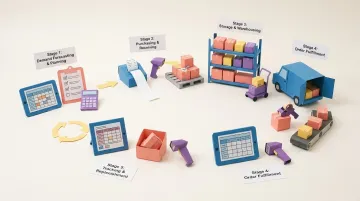
Stage 1: Demand Forecasting and Planning
Demand forecasting is the foundation of the entire process. It uses historical sales data, seasonality trends, supplier lead times, and market signals to estimate how much stock will be needed and when.
Key inputs to effective forecasting:
- Past sales velocity by SKU
- Promotional calendars and seasonal patterns
- Supplier lead time variability
- Market trends and external signals
When forecasting is skipped or done poorly, the consequences cascade downstream: overstock ties up capital, stockouts trigger emergency orders at premium costs, and warehouse capacity is misallocated. For Consumer Packaged Goods industries, the average forecast error is 39%.
Modern operations teams use forecasting to set reorder points and safety stock levels. These outputs govern stages 2 and 5. A 10-20% improvement in forecast accuracy can trim inventory costs by 5% and boost pre-tax profit by 3% or more.
Stage 2: Purchasing, Receiving, and Inspection
Purchasing translates forecasted demand into purchase orders, then receiving and inspection determine whether incoming goods actually match what was ordered. Accuracy here is critical — errors propagate forward through every subsequent stage.
A thorough receiving and inspection process involves:
- Verifying quantities against purchase orders
- Confirming SKU and barcode accuracy
- Checking product condition and damage
- Handling special requirements (temperature for perishables, serial verification for electronics)
Items should only be logged into inventory systems once they pass inspection. Best-in-class operations receive supplier orders damage-free at ≥99.07%, and complete dock-to-stock cycles in under 3.5 hours.
Reliable suppliers reduce receiving errors directly. Clear purchase order processes and consistent communication prevent stockouts caused by late or incorrect shipments. For UK importers, less predictable lead times and customs checks on goods from outside the UK mean carrying higher safety stock on critical lines.
Stage 3: Storage and Warehousing
Once goods pass inspection, strategic storage decisions directly affect fulfilment speed and accuracy. Warehouse slotting—organising inventory by SKU, product type, and sales velocity—reduces pick times and minimises errors.
Best practices for storage:
- Place fast-moving products in accessible locations near packing stations
- Use a warehouse management system (WMS) to log stock locations
- Maintain clear labelling to support accurate cycle counts
- Organise by product category, size, or handling requirements
Slotting optimisation reduces picking walk distances by 15-30% and improves capacity utilisation by 20-40%. Optimal slotting can reduce locations visited per wave by 44%.
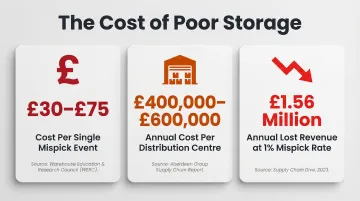
The cost of poor storage is significant. Every mispick means labour to correct it, a return to process and a second delivery, and those costs add up quickly across a busy distribution centre.
Stage 4: Order Fulfilment
Order fulfilment spans everything from the moment a customer places an order to the moment delivery is confirmed — picking, packing, shipping, and customer notification.
Operational elements that determine fulfilment performance:
- Choose a picking method (batch, zone, or wave) based on order volume and SKU distribution
- Standardise packing to protect product integrity and reinforce brand experience
- Select carriers by balancing cost, speed, and reliability for each route (in the UK, compare options such as Royal Mail, DPD, Evri and Parcelforce)
- Share real-time tracking updates with customers throughout the delivery journey
Delivery experience and a choice of delivery options influence whether customers buy again, so despatch cut-off times and tracking updates matter as much as stock accuracy.
Operations teams face a make-or-buy decision at this stage: handle fulfilment in-house or partner with a third-party logistics provider (3PL). Many e-commerce brands outsource some or all fulfilment to a 3PL for negotiated carrier rates and extra capacity, while others keep it in-house for control over packing, cut-off times and quality checks.
Stage 5: Inventory Tracking, Monitoring, and Replenishment
Real-time visibility makes the rest of the process functional. Stage 5 covers stock level monitoring, cycle counts, discrepancy detection, reorder triggering, and performance reporting.
Good inventory tracking includes:
- Real-time stock visibility by SKU and location
- Automated reorder alerts when stock hits predefined thresholds
- Audit trails for discrepancies and adjustments
- Reporting on inventory turnover and carrying costs
Implementing real-time inventory tracking systems reduces stockout rates from 12% to 7% and overstock rates from 18% to 12% across industries. It also decreases the time required for manual stock checks by 35%.
Best-in-class operations maintain inventory count accuracy by location at ≥99.5%. Companies with the highest inventory accuracy spend just 5% of total product cost on inventory, while bottom performers spend about three times more.
Tracking feeds directly back into Stage 1. The data collected here—sales velocity, waste, overstock patterns—sharpens the next forecasting cycle and makes the whole process progressively more accurate over time.
Key Factors That Affect Each Stage
Several variables determine how well the inventory management process performs across all stages.
Data quality: Garbage-in, garbage-out applies at every stage. Inaccurate SKU data, unrecorded stock movements, or manual entry errors undermine forecasting, receiving, and tracking simultaneously. Experienced spreadsheet users make errors in 2-5% of all formula cells, meaning large business spreadsheets have a near 100% probability of containing significant errors.
Supplier reliability: Inconsistent lead times force businesses to carry higher safety stock and make forecasting harder. 94% of companies reported supply chain disruptions negatively affecting revenue in 2024/2025 — disruptions that typically inflate operating expenses by 3-5% and cut sales by roughly 7%.
Tooling flexibility: Teams using rigid legacy systems or spreadsheets struggle to adapt workflows as their business evolves. Linking receiving inspection to stock records, or tying reorder alerts to supplier lead time data, requires systems that can be configured without months of development work. Platforms like Keel let fast-moving operations teams build and own custom inventory workflows, offering a practical alternative to one-size-fits-all ERPs. Keel is built by Planko Ltd, a company registered in the United Kingdom and registered with the ICO (ZB524558).
Scale and multi-channel complexity: Managing inventory across multiple warehouses, sales channels, or product categories multiplies the coordination burden at every stage and demands more robust systems and cleaner data models.
Common Challenges and Misconceptions
The most widespread misconception is that inventory management is primarily a warehouse or logistics problem. In reality, the biggest failures typically originate in Stage 1 (poor forecasting) or Stage 5 (inadequate tracking), not in the warehouse itself. Two specific patterns account for most of these failures.
The Overstock/Stockout Trap
Many teams over-correct from stockouts by building excessive safety stock, which ties up capital and creates write-off risk. 73% of retailers report difficulty predicting demand accurately, creating cycles of stockouts alternating with surplus. The fix isn't more stock — it's better forecasting and tighter reorder triggers.
The Tooling Bottleneck
Businesses often outgrow spreadsheets but find off-the-shelf inventory software too rigid for their specific workflows. When that happens, teams work around their tools rather than with them — introducing manual errors and creating blind spots across all 5 stages.
The solution isn't a more expensive package. It's tooling that teams can shape around their own processes, iterate on quickly, and actually own.
Frequently Asked Questions
What are the 5 stages of the inventory management process?
The 5 stages are demand forecasting and planning, purchasing and receiving, storage and warehousing, order fulfilment, and inventory tracking and replenishment. They form a continuous loop rather than a one-time sequence, with tracking data feeding back into forecasting. For UK businesses, the purchasing stage also covers customs and import VAT on non-UK supplies, and tracking supports the year-end stocktake.
What are the 5 W's of inventory management?
The 5 W's framework covers five dimensions: What (products in stock), Where (stock location), When (reorder timing), Who (stage ownership), and Why (why items are or aren't moving). Together they build accountability and visibility across the entire process.
What is the difference between inventory management and inventory control?
Inventory control is a subset of inventory management focused on stock you already hold: organisation, counts, stocktakes and shrinkage prevention. Inventory management is the broader end-to-end process covering forecasting, purchasing, goods-in, fulfilment and tracking. In the UK the terms stock control and stock management are often used for the same ideas.
What is the most important stage of the inventory management process?
Demand forecasting (Stage 1) is typically the most consequential stage. Errors here cascade into every downstream stage and are harder to correct once procurement and storage decisions have already been made.
How does demand forecasting improve the inventory management process?
Accurate forecasting sets the correct reorder points, safety stock levels, and purchasing quantities. This reduces both stockouts and overstock while aligning warehouse capacity and supplier lead times with actual demand.
What tools are used to manage inventory across all 5 stages?
The main categories are inventory management software (IMS) and warehouse management systems (WMS) for tracking and storage, ERP or operations platforms for end-to-end workflow, and barcode/RFID technology for real-time visibility. The right fit depends on business size, channel complexity, and how much flexibility your team needs.
What are the steps in the inventory control process?
The inventory control process follows five practical steps: receive and inspect stock against the purchase order, put it away to a recorded location, keep stock records updated as items are picked and despatched, count stock regularly through cycle counts or a stocktake, and investigate and adjust any differences with a reason code. Inventory control focuses on stock you already hold, while the wider inventory management process also covers forecasting and purchasing.
What is the inventory management cycle?
The inventory management cycle is the repeating loop of forecasting demand, purchasing and receiving stock, storing it, fulfilling orders and tracking stock levels. It is a cycle rather than a straight line because tracking data such as sales velocity, waste and discrepancies feeds back into the next forecast. Each pass should sharpen reorder points and safety stock, so the process becomes more accurate over time.
What is inventory lifecycle management?
Inventory lifecycle management is the control of stock from the moment it is bought to the moment it leaves the business. For manufacturers that means raw materials, work in progress and finished goods; for retailers and distributors it runs from goods-in to sale, return or write-off. Managing the lifecycle means recording each transition, rotating stock by date, and spotting slow-moving or expiring items before they lose value.
What does an inventory process flow chart include?
An inventory process flow chart maps each step stock goes through and who is responsible for it. A typical chart includes the reorder trigger, purchase requisition and purchase order, goods-in and inspection, quarantine for failed items, put-away, picking and packing, despatch, cycle counts and stock adjustments. Decision points, such as whether a delivery matches the purchase order, show where exceptions are routed and approved.
How often should UK businesses do a stocktake?
Most UK businesses do a full stocktake at least once a year, at their financial year end, so their accounts show an accurate closing stock figure. Many also run cycle counts weekly or monthly, counting high-value or fast-moving lines more often. Businesses with strong cycle counting and reliable stock records may be able to reduce reliance on a single annual count, but should agree the approach with their accountant.
Which stock valuation methods can UK businesses use?
UK businesses reporting under FRS 102 can value stock using first in, first out (FIFO) or weighted average cost, and specific identification for items that are not interchangeable. LIFO is not permitted under FRS 102. Stock is then carried at the lower of cost and estimated selling price less costs to complete and sell. Your inventory system should record costs consistently so the chosen method can be applied at year end.