Introduction
For UK manufacturers facing global competition, cost pressures, supply chain disruption and labour shortages, lean management is one of the most practical ways to get more from the same people, space and equipment. According to Make UK, over 70% of UK manufacturers cite global competition and cost pressures as major challenges, and the Office for National Statistics has reported that UK manufacturing productivity lags behind other G7 nations.
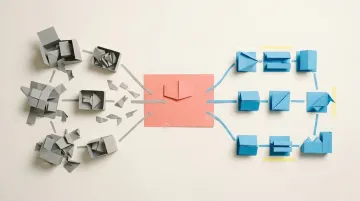
Lean manufacturing is a production philosophy centred on cutting waste at every step, so more of your effort goes into what customers actually pay for. Rooted in the Toyota Production System developed in post-war Japan, it has spread from car plants to food and drink, aerospace, healthcare and logistics.
This guide explains lean management principles in plain terms: the five core principles, the eight types of waste, a step-by-step implementation strategy and the tools that sustain continuous improvement, with the UK context manufacturers need to apply them.
What Is Lean Manufacturing?
Lean manufacturing is a management approach focused on delivering maximum value to the customer by removing any step, activity, or resource that doesn't contribute to that value. It's a philosophy and culture first — the tools come second.
An activity is considered value-added only if the customer is willing to pay for it and it changes the product's form or function.
Origins: From the Toyota Production System to a Global Standard
The Toyota Production System (TPS) was developed between 1948 and 1975 by Taiichi Ohno and Eiji Toyoda, with significant industrial engineering contributions from Shigeo Shingo. Post-WWII Japan faced severe resource scarcity, forcing Toyota to compete with American mass production using fundamentally different methods. TPS rests on two pillars: Jidoka (automation with a human touch, allowing machines to detect defects and stop) and Just-in-Time (synchronising processes to make only what is needed, when it is needed).
The term "lean production" was formally coined in 1990 by James P. Womack, Daniel T. Jones, and Daniel Roos in The Machine That Changed the World, based on a five-year MIT study. In 1996, Womack and Jones codified the five core lean principles in Lean Thinking: Banish Waste and Create Wealth in Your Corporation, giving organisations a replicable framework beyond the automotive sector.
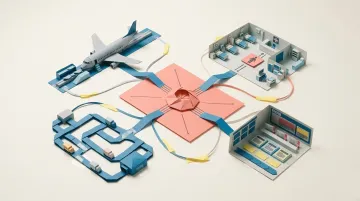
Lean has since taken hold across industries well outside automotive:
- Boeing cut 737 assembly time from over 30 days to just 8 by implementing continuous flow
- ThedaCare reduced inpatient costs by 25% whilst improving patient satisfaction to nearly 100%
- DHL used lean alongside IoT and AI to optimise delivery routes
- BBC Worldwide applied Kanban to software development, cutting delivery lead time by 37% and reducing defects by 24%
The 5 Core Principles of Lean Manufacturing
The five principles codified by Womack and Jones in 1996 form a continuous cycle, not a linear checklist, and their practical application on the shop floor matters more than memorising them. Each principle feeds the next — and the cycle repeats indefinitely.
The Five Principles Explained
1. Define Value
Value must always be defined through the customer's lens, not internal assumptions. Only activities the customer is willing to pay for count as value-adding. In the Acme Stamping case study, the actual processing time to stamp and weld a part is only 188 seconds, yet total production lead time is 23.6 days due to transport, inspection, and waiting—all non-value-adding activities.
2. Map the Value Stream
Value stream mapping documents every step in the production process from raw materials to delivered product. The goal is to make all non-value-adding steps visible so they can be eliminated or reduced. This visualises the flow of both materials and information, exposing hidden waste in complex workflows.
3. Create Flow
Once waste steps are removed, the remaining value-adding steps should proceed without interruption, batching delays, or bottlenecks. Improving layout, reducing batch sizes, and eliminating handoff delays contributes to smooth continuous flow. The product flows toward the customer without stoppages, scrap, or backflows.
4. Establish Pull
Instead of pushing products based on forecasts, lean organisations produce only in response to actual customer demand. This Just-in-Time philosophy reduces overproduction, excess inventory, and tied-up capital. Pull systems provide processes with only the kinds and quantities of items they need, exactly when needed.
5. Pursue Perfection (Kaizen)
The pursuit of perfection is never complete. Continuous improvement (Kaizen) is embedded as a permanent cultural commitment involving every employee at every level. This principle sustains the other four over time. Toyota's Creative Idea Suggestion System generates 810,000 ideas annually—14.4 suggestions per employee—with a 70% implementation rate, demonstrating the power of frontline engagement.
The 8 Wastes of Lean Manufacturing (Muda)
"Muda" is the Japanese term for waste—any activity that consumes time, money, or resources without creating value for the customer. The Toyota Production System originally identified seven wastes; modern lean practice expanded this to eight with the addition of underutilised human talent.
Breaking Down the 8 Wastes (DOWNTIME)
| Waste | Definition | Manufacturing Example |
|---|---|---|
| Defects | Production of defective parts requiring inspection, rework, and scrap | Faulty welds requiring parts to be scrapped or reworked |
| Overproduction | Producing ahead of what is actually needed by the next process or customer | Manufacturing 1,000 units when only 500 are ordered |
| Waiting | Operators standing idle as machines cycle, equipment fails, or parts fail to arrive | Workers waiting 30 minutes for materials to arrive from the warehouse |
| Non-utilised talent | Under-utilisation of employees' brainpower, skills, experience, and creativity | Experienced operators never consulted on process improvements |
| Transportation | Unnecessary movement of materials between functional areas or warehouses | Moving parts across the facility multiple times during production |
| Inventory | Having more than the absolute minimum stocks necessary for a precisely controlled pull system | Excess raw materials sitting in storage for months |
| Motion | Unnecessary movement by employees during their work | Workers walking repeatedly to fetch tools stored far from workstations |
| Extra-processing | Performing unnecessary or incorrect processing due to poor tool or product design | Polishing surfaces that customers never see |
Taiichi Ohno and the Lean Enterprise Institute explicitly classify overproduction as the worst form of waste because it acts as a catalyst that creates and hides the other six wastes. Overproduction forces excess inventory, requires additional transportation and storage, masks defects, and hides underlying process problems.
How to Spot Waste in Your Operations
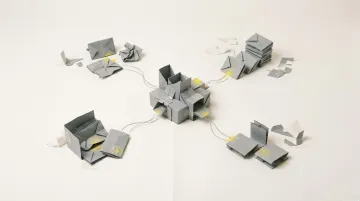
The Gemba Walk is the practice of going to the actual place of work (gemba means "actual place" in Japanese) to observe processes firsthand rather than relying on reports. Toyota Chairman Fujio Cho popularised the mandate: "Go see, ask why, show respect."
When conducting a Gemba Walk, managers should observe alignment of three elements:
- Purpose: What problem does this process solve for the customer?
- Process: How does work actually flow, and is it designed to achieve the purpose?
- People: Are employees engaged in creating, sustaining, and improving the process?
Gemba Walks capture what you see on the floor; Value Stream Mapping captures the whole picture. By diagramming every step in the material and information flows — from raw input to finished output — teams can compare the current state against a desired future state and identify exactly where delays, defects, and redundancies are costing them. That gap between the two maps becomes the roadmap for improvement.
Key Benefits of Lean Manufacturing
Cost Reduction and Throughput Improvement
Eliminating waste directly reduces operating costs through less rework, reduced excess inventory, shorter lead times, and better use of labour and equipment. A 2025 Deloitte survey of 600 manufacturing executives found that smart lean initiatives yielded 10% to 20% improvement in production output, 7% to 20% improvement in employee productivity, and 10% to 15% in unlocked capacity.
Improved Product Quality and Customer Satisfaction
There's a direct causal link between waste elimination—especially defects and overprocessing—and product quality. When 3M combined Lean Six Sigma to improve its belt fabrication processes, defects decreased by a factor of 28, driving a 54% increase in sales. Shorter lead times and more reliable delivery also drive measurable improvements in customer satisfaction and retention.
Employee Engagement and Organisational Culture
Lean creates a participative work environment where frontline workers are empowered to identify problems and drive improvements. This reduces turnover, increases ownership, and surfaces improvement ideas that management would otherwise miss. Addressing the eighth waste (non-utilised talent) through structured suggestion systems consistently produces higher engagement scores and measurable efficiency gains — often surfacing improvements no top-down process review would catch.
How to Implement Lean Manufacturing: A Step-by-Step Guide
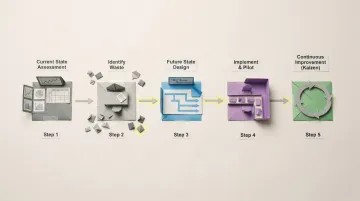
Lean implementation is a sustained organisational transformation, not a single project with a finish line, so it needs a clear lean management strategy rather than a one-off toolkit. Leadership commitment and genuine cultural willingness to change are prerequisites. Without both, even the best tools and techniques will fail to take hold.
Step 1: Conduct a Current-State Assessment with Value Stream Mapping
Document every process step from customer order to product delivery. Record cycle times, wait times, inventory levels, and defect rates. The current-state VSM becomes the honest baseline from which all improvement is measured. This visibility exposes where time is truly spent versus where value is actually created.
Step 2: Identify and Prioritise Waste
Analyse the current-state map through the lens of the eight DOWNTIME wastes. Prioritise waste-elimination efforts based on impact (time, cost, quality) and feasibility. Not all waste can be eliminated at once. Focus on the highest-leverage opportunities first. Look for waste that compounds other problems, particularly overproduction.
Step 3: Design the Future State and Set Measurable Goals
Redesign the process to remove identified wastes, introduce pull systems where appropriate, and optimise flow. Set specific, measurable targets for improvement — lead time reduction, defect rate, or inventory turns — so progress stays trackable. The future-state VSM should stretch the team while remaining achievable, with named accountability for each target.
Step 4: Implement Lean Tools and Run Pilots
Pilot changes in a contained area before scaling. Select appropriate lean tools (5S, Kanban, SMED, standard work) for the specific waste being addressed. Involve frontline workers in designing changes to improve buy-in and catch practical issues early. Rapid pilots allow teams to learn and adjust before full deployment.
Step 5: Sustain Improvements Through Continuous Improvement (Kaizen)
Embed ongoing improvement through regular structured practices: daily team stand-ups, periodic kaizen events, visual management boards, and regular metric reviews. Sustaining lean depends on operations systems that can actually keep pace with process changes. Rigid, legacy software creates a ceiling here — when updating a workflow requires a lengthy development cycle, teams stop iterating and Kaizen stalls. Platforms like Keel are built specifically for this: operations teams can modify workflows, update data models, and generate new internal tools without waiting on months of development work, keeping the improvement cycle genuinely continuous.
Lean Tools and Technology: The Modern Operations Edge
Essential Lean Tools
| Tool | Definition | Primary Wastes Addressed |
|---|---|---|
| 5S | Five-step methodology (Sort, Straighten, Shine, Standardise, Sustain) to create a visual, self-ordering workplace | Motion, Waiting, Defects |
| Kanban | Signalling device (card, bin, or electronic) that authorises production or withdrawal of items in a pull system | Overproduction, Inventory |
| Value Stream Mapping | Diagramming every step in material and information flows from order to delivery | All wastes (holistic identification) |
| SMED | Single-Minute Exchange of Die: reducing equipment changeover times to under 10 minutes | Waiting, Overproduction, Inventory |
| Poka-Yoke | Mistake-proofing through automatic devices or methods that prevent errors or make them immediately obvious | Defects, Extra-processing |
| Heijunka | Production smoothing: levelling the type and quantity of production to efficiently meet customer demand | Overproduction, Waiting |
The Digital Lean Multiplier
Integrating Industry 4.0 technologies with lean foundations produces measurable, compounding gains. McKinsey reports that an Asian automotive company reduced die manufacturing time by 47% by connecting all production machinery to a real-time IoT monitoring system that automatically detects bottlenecks. AI-based visual inspection systems are also being used to catch defects that manual inspection can miss.
Digital technology supports lean principles through:
- Real-time production monitoring via IoT sensors
- Data analytics for more accurate demand forecasting
- Automated pull triggers that respond to actual consumption
- End-to-end inventory visibility across the value stream
Avoiding the Legacy ERP Bottleneck
That digital capability is only as strong as the systems underneath it. Gartner warns that by 2027, more than 70% of recently implemented ERP initiatives will fail to fully meet their original business case goals. Monolithic legacy ERP architectures force static, batch-based scheduling that fundamentally clashes with lean's requirement for agile, continuous flow. The right technology should flex to the business's lean processes, not the other way around. Platforms that give operations teams direct control over their tools and data models are better aligned with lean's philosophy of eliminating non-value-adding constraints.

Frequently Asked Questions
What is lean management in manufacturing?
Lean management in manufacturing is a systematic approach to eliminating waste and maximising customer value across production operations. Rooted in Toyota Production System principles, it combines shop-floor practices such as flow, pull and 5S with a management strategy of daily review and continuous improvement. UK manufacturers use it to respond to cost pressures, skills shortages and the productivity gap through disciplined, organisation-wide practice.
What are the 5 P's of lean manufacturing?
The core 4 P's are Purpose (core values and business goals), Process (how products are made), People (workers identifying improvements), and Performance (how leaders test and refine results). A fifth P — Problem-solving or Prosperity — is added in some models to capture the structured approach to resolving operational challenges.
What are the C's of lean manufacturing?
The 5 C's of Lean translate the 5S workplace organisation framework: Clear Out (remove unnecessary items), Configure (organise what remains), Clean and Check (maintain cleanliness and inspect), Conformity (standardise practices), and Custom and Practice (sustain improvements through habit). Some models reference the strategic 3 C's: Customers, Competitors, and Company.
What is the difference between lean manufacturing and Six Sigma?
Lean focuses on eliminating waste and improving flow to increase speed and efficiency. Six Sigma focuses on reducing process variation and defects using data-driven statistical methods to improve quality. The two are frequently combined as Lean Six Sigma, targeting both flow efficiency and near-zero defect rates within a single improvement programme.
What are the most common lean manufacturing tools?
The most widely used tools are 5S (workplace organisation), Value Stream Mapping (process analysis), Kanban (visual workflow management), Kaizen events (rapid improvement workshops), SMED (rapid changeover), and Poka-Yoke (error-proofing). The appropriate tools depend on the specific type of waste or process challenge being addressed.
How long does lean manufacturing implementation typically take?
Initial results from lean pilots can appear within weeks, but full organisational transformation takes years rather than months. Sustainable lean requires genuine shifts in management culture, and the pace varies with organisational scale and leadership commitment.
What are lean management principles, explained simply?
Lean management principles are five steps for removing waste: define value from the customer's point of view, map the value stream, create flow, establish pull so you only make what is ordered, and pursue perfection through continuous improvement (kaizen). On a UK shop floor that means cutting waiting, rework and excess stock so more of every shift goes into work customers pay for.
What is the difference between lean management and lean manufacturing?
Lean manufacturing applies lean thinking to production: flow, pull, changeovers and waste on the shop floor. Lean management is the wider leadership system that sustains it, covering strategy, coaching, gemba walks and daily reviews, and applying the same principles to offices, planning and the supply chain. UK manufacturers usually need both, because shop-floor gains fade without management routines behind them.
How should a UK manufacturer start a lean management strategy?
Start small and measurable. Pick one product family or bottleneck, map its current value stream and agree two or three targets such as lead time, on-time delivery or scrap. Run a pilot with the people who do the work, update risk assessments where layouts or methods change, then standardise what works before rolling it out. Leadership commitment matters more than any single tool.
Is there support in the UK for lean and digital manufacturing projects?
Yes, but it depends on where you are. Make UK and regional manufacturing networks run events and benchmarking, and the government-backed Made Smarter adoption programme has offered SME manufacturers in parts of England advice and match funding for digital technology. Check current eligibility with your local growth hub, because programmes, regions and funding rounds change.
Does lean manufacturing conflict with UK health and safety rules?
No, but changes must be managed safely. Moving machines, shortening changeovers or altering standard work can create new risks, so employers still need suitable risk assessments under the Health and Safety at Work etc. Act 1974 and must keep work equipment safe under PUWER. Done well, 5S and standard work support safety by reducing clutter, motion and improvisation.
What software supports lean manufacturing for UK SMEs?
Lean needs systems that make flow, stock and quality visible without extra admin: works orders, inventory, purchasing and shop-floor data in one place. Spreadsheets struggle as you grow, while legacy ERPs can be slow to change. Keel, from UK-registered Planko Ltd, lets manufacturers build production, inventory and procurement workflows around their own processes and change them as their lean programme evolves.