Introduction
UK operations teams face the same operational paradox as everywhere else: spreadsheets are too simple, legacy enterprise software is too rigid, and off-the-shelf tools force unique workflows into generic templates. Custom software product development solves this by building systems around how your business actually operates, not around a vendor's average customer. It's also a well-established route in the UK market — there are an estimated 30,000 companies in the UK providing custom software services, from large consultancies to two-person teams, according to propeltech.co.uk.
Custom software product development is often discussed in terms of upfront cost and build time. But its real value is operational: the ability to own, evolve, and scale systems that match how your business actually works. That ownership translates into systems that move when you move — not six months later.
What follows covers the concrete business outcomes custom software development delivers — from operational efficiency to long-term cost control — and why more UK and international operations teams are choosing to build rather than buy.
Key Takeaways
- Custom software means building systems tailored to your workflows, data, and processes — not forcing your operations into a generic tool's constraints
- Core benefits are operational: full ownership, precise workflow fit, and scalable systems that compound in value over time
- With custom software, you own the logic, data model, and roadmap outright — no vendor lock-in, no forced compromises
- Cost is higher upfront, but long-term ROI is stronger because the software grows with you rather than constraining you
- Custom development makes most sense for companies with unique operational complexity, regulatory requirements, or fast-changing processes
- An estimated 30,000 companies in the UK provide custom software development services (propeltech.co.uk) — a sign of how established the build-vs-buy decision already is in the UK market
- Generic, non-personalised software carries a real customer-experience cost: McKinsey research cited by propeltech.co.uk finds 71% of consumers expect personalised interactions and 76% get frustrated when brands don't deliver them
What Is Custom Software Product Development?
Custom software product development is the process of designing and building software from the ground up to match the specific workflows, data structures, and operational needs of your business—not a generic user base.
Where it's typically applied:
- Internal operations tools and workflow automation
- Order and inventory management systems
- Custom CRM and fulfilment platforms
- Compliance and regulatory workflows
- Warehouse and production management
- Procurement and supply chain systems
The real payoff is operational control: systems that fit your processes exactly, evolve when your business does, and eliminate the friction that slows teams down and creates errors.
Key Benefits of Custom Software Product Development
The benefits below are anchored in operational impact—cost, speed, control, risk, and scalability—not abstract technical claims.
Benefit 1: Full Ownership and Control Over Your Software
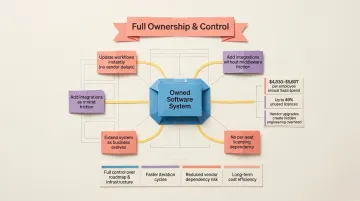
Ownership means your business controls the codebase, data model, feature roadmap, and infrastructure. No vendor dictates what's possible or when changes happen.
How this plays out in practice:
- Update workflows without waiting months for vendor release cycles
- Add integrations without middleware workarounds
- Extend systems as processes evolve
- Eliminate per-seat licensing fees and contractual upgrade dependencies
Why this matters:
Vendor lock-in creates compounding hidden costs. In the US, mid-market firms now spend between $4,830 and $5,607 per employee annually on SaaS, yet 49% of provisioned licences go completely unused. This results in up to $21 million in annual wasted spend per organisation.
Vendor roadmaps create unpredictable technical debt. When vendors force upgrades—like Salesforce retiring Platform API versions 21.0 through 30.0 in 2025—companies spend engineering hours upgrading just to maintain existing functionality.
Ownership eliminates these friction points. Teams that own their tools iterate faster, respond to market changes sooner, and protect proprietary operational logic from competitors.
KPIs impacted:
- Software licensing cost per employee
- Time-to-deploy new workflows
- Number of manual workarounds required
- Operational dependency on third-party roadmaps
When this benefit matters most:
Most impactful at scale—when licensing costs multiply with headcount, when operational complexity outgrows what SaaS vendors support, or when the business operates in regulated sectors where data sovereignty and auditability are non-negotiable.
Benefit 2: Precise Fit for Unique Workflows and Operational Complexity
Generic software is built for the average business, which means it handles average workflows well and unusual ones poorly. Custom software is built around what your operations actually do—including edge cases, exceptions, and proprietary processes that define your business.
What this looks like in practice:
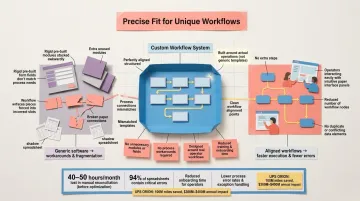
- No unnecessary modules or fields that don't apply to your business
- No workarounds to adapt your process to the software's logic
- Interfaces designed around how operators actually work
- Reduced friction, errors, and training time
Why this matters:
Forcing complex operations into generic software leads to manual data reconciliation, shadow spreadsheets, and process fragmentation. 90% of firms still rely on spreadsheets for critical processes despite heavy enterprise software investments.
The operational cost is severe. Finance and operations teams lose 40 to 50 hours per month purely on manual data entry and reconciliation between disconnected systems. Research confirms that 94% of business spreadsheets contain critical errors.
When software mirrors your process exactly, operators make fewer mistakes, onboard faster, and execute at higher throughput. UPS's custom ORION routing system shows what's possible when software is built around operational reality rather than adapted to it—ORION saves UPS 100 million miles, 10 million gallons of fuel, and $300 million to $400 million annually.
KPIs impacted:
- Error rates in operations workflows
- Time spent on manual data entry or reconciliation
- Operator onboarding time
- Process cycle time
- Volume of exceptions requiring human escalation
When this benefit matters most:
Highest impact for businesses with non-standard operations—regulated industries (healthcare, finance, logistics), companies with complex multi-step fulfilment, or teams managing high-volume, time-sensitive workflows where precision directly affects customer outcomes.
Benefit 3: Long-Term Scalability and Compounding ROI
Custom software is built with your growth trajectory in mind. The architecture, data model, and integrations are designed to expand as the business scales, rather than hitting the ceiling of a vendor's pricing tier or feature set.
Scalability in practice:
- Adding new product lines, geographies, or operational workflows doesn't require migrating to a new platform
- No waiting for vendor support—extend systems you already own and understand
- Infrastructure scales elastically with demand
- New features build on existing foundation rather than requiring workarounds
Why this matters:
The upfront investment depreciates over time while the value increases. Unlike SaaS—where costs grow with usage while the product stays static—custom software becomes more valuable as it encodes institutional knowledge and operational logic unique to your business.
Annual maintenance for custom software typically equals 15% to 25% of initial development cost, while 73% of SaaS providers raised prices by an average of 12% in a single year. The Total Cost of Ownership (TCO) break-even point typically occurs between years three and five for operations-heavy firms.
Platform migrations are failing at alarming rates. Among US enterprises, 57% spent over $1 million on migrations last year, facing average cost overruns of $315,000 per project. McKinsey notes that 70% of ERP projects fall short of their goals.
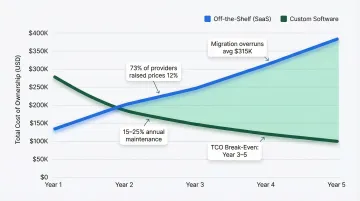
Businesses whose software scales with their operations don't lose speed to tooling bottlenecks—they build on a foundation that accelerates rather than limits growth.
KPIs impacted:
- Cost per transaction at scale
- Time-to-onboard new operational workflows
- Total cost of ownership over 3-5 years
- Infrastructure cost as percentage of revenue
When this benefit matters most:
Most relevant for fast-growing companies approaching the limits of no-code or entry-level SaaS tools, and for operations teams managing increasing volume where per-seat or per-transaction pricing makes off-the-shelf options prohibitively expensive.
What Happens When Businesses Skip Custom Software Development
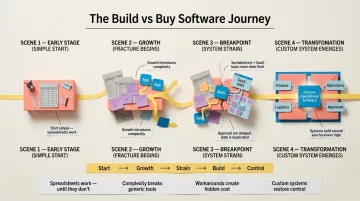
Businesses typically rely on stitched-together off-the-shelf tools—a CRM here, a spreadsheet there, a legacy ERP underneath. The operational debt compounds over time as each workaround creates new fragility.
The real cost shows up not in the software budget but in operational outcomes:
- Inconsistent process execution as teams develop unofficial workarounds that vary by person or team
- Rising error rates as data moves manually between disconnected systems
- Inability to scale operations without proportionally scaling headcount
- Difficulty delegating or automating because process logic lives in people's heads, not in the system
- Competitive disadvantage as the business cannot iterate operations as fast as the market requires
Real-world operational breakdowns:
In November 2024, a ransomware attack on Blue Yonder forced major retailers like Starbucks to revert to pen-and-paper scheduling. Every hour of downtime in a Tier 1 logistics operation can cost between $250,000 and $800,000.
In 2024, the SEC fined 26 financial firms a combined $392.75 million for recordkeeping failures tied to "off-channel communications"—a direct result of employees bypassing clunky corporate software.
The Echo Story: From Operational Necessity to Competitive Advantage
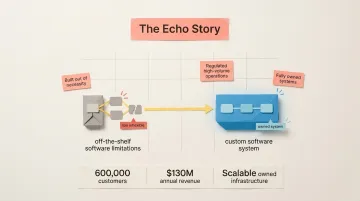
Before founding Keel in 2021, the team worked at Echo, Europe's fastest-growing online pharmacy. They built extensive custom software out of necessity — off-the-shelf options were too inflexible for a regulated, high-volume pharmacy operation, so they had no choice but to build their own.
This custom software became a core competitive advantage, helping them scale to 600,000 customers and $130m (USD) in annual revenue — with systems they owned outright and could evolve at their own pace.
Keel exists so operations teams can start with that foundation rather than spend years building it under pressure.
How to Get the Most Value from Custom Software Product Development
The ROI of custom software depends on how it's approached—not just what is built, but how ownership, iteration, and operational review are maintained after launch.
Value compounds when:
- Iterate on the software as workflows evolve, rather than treating it as a one-time build that goes static after launch
- Involve operators in the design process — the people closest to the work should define how the system behaves, not just developers interpreting requirements from a distance
- Launch core workflows first and extend incrementally, reducing risk and ensuring the system reflects real operational needs rather than assumed ones
Applying these principles consistently is where the compounding value comes from. Platforms like Keel are built to make that easier — enabling operations teams to launch, test, and evolve custom systems in weeks rather than months. With full ownership of the data model and infrastructure, and no need for a large internal engineering team to maintain it, businesses can capture the benefits of custom software without the traditional cost and complexity.
Frequently Asked Questions
What is custom software development?
Custom software development is the process of designing and building software specifically for the unique needs, workflows, and data requirements of a particular business, as distinct from purchasing and deploying a generic off-the-shelf solution.
What are the 7 stages of SDLC?
The standard Software Development Life Cycle stages are: planning, requirements analysis, system design, implementation (coding), testing, deployment, and maintenance. Modern custom development often uses agile iterations rather than a strictly linear sequence.
What is the difference between custom software and off-the-shelf software?
Off-the-shelf software is pre-built for a broad user base and requires businesses to adapt their processes to fit the tool. Custom software is built around the specific workflows and data of one business, giving teams greater fit, control, and long-term flexibility over how their operations run.
How long does custom software product development take?
Timelines vary by complexity, but modern approaches and purpose-built platforms can compress delivery significantly. Core systems can be operational in weeks with features added iteratively, versus months for traditional enterprise builds.
Is custom software development worth the cost?
Upfront investment is higher than off-the-shelf licensing, but custom software delivers stronger long-term ROI for operations-heavy businesses. It eliminates per-seat licensing costs, reduces manual workarounds, and scales without architectural re-platforming.
When should a company invest in custom software product development?
Three clear signals point to the right moment: off-the-shelf tools require significant workarounds, operational or regulatory complexity exceeds what generic software supports, or the business is scaling rapidly and needs systems that grow with it. Any one of these is reason enough to consider a custom build.
Does custom software product development need to account for UK data protection rules?
Yes. Any system handling customer or operational data for a UK business needs to meet UK GDPR and Data Protection Act 2018 obligations, regulated by the Information Commissioner's Office (ICO). This is one reason compliance and regulatory workflows are a common application area for custom software — the audit trail and access controls can be built in from the start rather than bolted on later. Keel itself is ICO registered (reference ZB524558).
What does custom software product development typically cost for a UK business?
Cost depends heavily on complexity, integrations and regulatory requirements, so there's no single figure that applies across businesses. What's more consistent is the pattern: upfront investment is higher than off-the-shelf licensing, but Total Cost of Ownership typically breaks even within 3-5 years as licensing fees and workaround costs disappear. Most UK vendors, including Keel, quote in GBP once they understand your specific scope.
Does custom software help regulated UK industries like pharmacy or food and beverage stay compliant?
It can. Regulated UK sectors — pharmacy overseen by the MHRA, food and beverage overseen by the FSA — need audit trails, traceability and approval workflows that generic software often bolts on rather than builds in. Keel's own founders faced this directly at Echo, where they built custom software to run a high-volume, regulated pharmacy operation because off-the-shelf tools weren't flexible enough for the compliance demands of the sector.