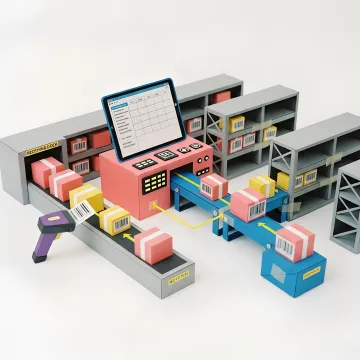
What is warehouse control software and how is it different from a WMS?
A Warehouse Management System (WMS) handles high-level inventory and order workflows, while warehouse control software (WCS) coordinates the workflow and data layer that runs warehouse execution—turning orders into picking, packing, and shipping tasks and tracking them to completion. Keel bridges both, delivering a fully custom system that handles inventory, picking, packing, shipping, and order data in one unified platform tailored to your exact operation, without directly controlling physical or automation equipment.
How long does a warehouse control software implementation typically take?
With Keel's Build for Me service, most clients go live within a matter of weeks. The timeline depends on the complexity of your warehouse layout, integrations required, and custom workflows. Unlike traditional ERP implementations that take months or years, Keel's code-first approach and structured onboarding process are designed to get you operational quickly without sacrificing configurability.
Can Keel integrate with our existing systems, carriers, and e-commerce platforms?
Yes. Keel is built for seamless integration with your existing tech stack. We connect with e-commerce platforms such as Shopify and Amazon, third-party logistics providers (3PLs), carrier APIs for automated label printing and tracking sync, financial systems, IoT devices like smart shelves and sensors, and virtually any API your operations currently rely on.
Do we need a large in-house development team to implement or maintain the system?
No. Keel's platform is designed for operators, not large engineering teams. Through the Build for Me service, Keel models and builds the system around your processes in real time and hands full ownership over to your team. The platform uses a code-first approach built on engineering best practices, so your team can iterate on workflows confidently without needing a dedicated developer for every change.
How is Keel different from off-the-shelf warehouse management software?
Off-the-shelf WMS tools are built around generic assumptions and force you to adapt your operations to their templates. Keel is built around your actual warehouse — your layout, your naming conventions, your edge cases. There are no compromises or workarounds. You own the system entirely, can evolve it as your business grows, and are never dependent on a vendor's roadmap or licensing restrictions.
Does Keel support multi-location warehouses and complex inventory structures?
Absolutely. Keel's inventory management handles stock across multiple locations, warehouses, and bin-level tracking. It supports complex SKU structures, product variants, lot and batch tracking, serial numbers, expiry dates, quarantine statuses, and inter-warehouse transfers. Automated reorder points, demand-based suggestions, and inventory valuation methods such as FIFO and average cost are all included.
What compliance and data security standards does Keel meet?
Keel (operated by Planko Ltd) is registered with the UK's Information Commissioner's Office (ICO), reference ZB524558. The platform includes built-in role-based and row-level access control, deny-by-default permissions, end-to-end type safety, OpenTelemetry observability, and a complete audit trail—essential for teams operating in regulated industries.
What happens after go-live — can we make changes to the system ourselves?
Yes — full ownership is a core principle of the Keel platform. After handover, your team can iterate on workflows, adjust rules, add new integrations, and evolve the system without starting from scratch or engaging expensive consultants. The version-controlled, code-first architecture means changes are safe, testable, and reversible, giving operations teams genuine control over their software long-term.
Is Keel's warehouse control software hosted in the UK?
Keel's multi-region data residency lets you choose where your warehouse data is hosted, including in the UK. Keel is operated by Planko Ltd, a company registered in the United Kingdom, and is registered with the UK's Information Commissioner's Office (ICO, reference ZB524558).
Does Keel's warehouse control software support GBP billing and VAT?
Yes. Keel is billed in GBP with VAT added, so UK operations teams aren't managing currency conversion for their subscription. Order Management within the platform also handles the customer-facing taxes and pricing your warehouse applies at checkout or on outbound orders.
Can Keel's warehouse control software support multiple UK sites?
Yes. Inventory Management tracks stock across multiple locations, warehouses, and down to the bin level, with inter-warehouse transfers, so UK operations running more than one site can manage them from a single system rather than stitching together separate tools.