
Introduction
For a UK operations team, the moment arrives quietly but unmistakably: your spreadsheet crashes mid-update, your warehouse team is buried under manual order entry, and your customer just received the wrong product for the third time this month. You realise your manual processes can no longer keep pace with order volume, and fulfilment software becomes the obvious next step.
But choosing the wrong platform can create just as many problems as it solves. Rigid workflows, hidden integration fees, and systems that buckle under peak-season load plague teams who rushed their decision — and UK buyers have their own checklist on top of the basics: where your order data is hosted, whether pricing is quoted in pounds or dollars, and whether VAT is added on top.
This guide gives you a clear framework for choosing well. We cover what fulfilment software actually is, which features genuinely matter, how pricing really works, what to watch for in reviews, and when off-the-shelf tools stop working — so you can choose the right solution for your operation.
Key Takeaways
- Fulfilment software automates order-to-delivery workflows including picking, packing, shipping, and returns
- Critical features include real-time inventory tracking, order routing rules, multi-carrier integrations, and complete audit trails
- Pricing ranges from £12/month for basic SaaS to £2,000+/month for mid-market WMS — hidden integration costs often exceed the headline fee
- Off-the-shelf tools fail when operations require complex workflows, regulatory compliance, or rapid iteration
- Custom operations platforms offer total control for teams outgrowing rigid SaaS limitations
- UK buyers should also check where fulfilment data is hosted, whether pricing is quoted in GBP or USD, and whether VAT is added on top of the headline price
- If you sell via Amazon FBA into the UK or EU, your fulfilment model can affect where you need to register for VAT — check with your accountant or HMRC
What Is Fulfilment Software?
Fulfilment software is a category of operations tools designed to manage the end-to-end process of receiving, processing, picking, packing, shipping, and returning customer orders. Unlike basic shipping tools that simply generate labels or generic inventory apps that track stock levels, fulfilment software automates the entire order-to-ship process, connecting selling channels, warehouse workflows, and shipping carriers so orders move from checkout to delivery with fewer manual steps.
How Fulfilment Software Differs from WMS and OMS
The operations software market uses overlapping terminology that confuses procurement decisions. Understanding the boundaries between fulfilment software, warehouse management systems (WMS), and order management systems (OMS) is critical:
| System Category | Core Focus | Primary Capabilities | Target User |
|---|---|---|---|
| Fulfilment Software | End-to-end order processing | Multi-channel order sync, shipping label generation, carrier rate shopping, basic inventory tracking | Ecommerce brands, SMBs, 3PLs |
| WMS | Physical facility execution | Directed put-away, wave/batch picking, barcode scanning, labour management, cycle counting | Warehouse managers, distribution centre operators |
| OMS | Order lifecycle orchestration | Distributed order routing, enterprise inventory visibility, payment validation, returns initiation | Omnichannel retailers, supply chain planners |
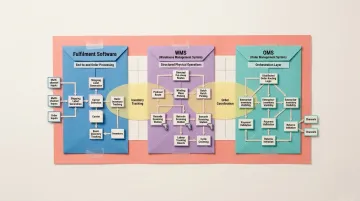
Fulfilment software bridges sales channels and shipping carriers directly — WMS handles the physical reality of the warehouse floor, while OMS manages strategic order routing across multiple locations.
Who Uses Fulfilment Software and When
Businesses typically adopt dedicated fulfilment software when operational complexity outpaces human capacity. Two trends are driving adoption:
- 86% of brands now sell on two or more sales channels, making manual inventory synchronisation impossible without risking stockouts or overselling
- 84% of brands use third-party logistics (3PL) providers for at least some orders, requiring centralised visibility across both internal warehouses and external 3PL nodes
Operations teams managing 500+ orders monthly typically start hitting bottlenecks that signal the need for automation. Ecommerce brands, 3PL providers, omnichannel retailers, and regulated-industry operations teams all rely on fulfilment software to maintain accuracy while scaling.
Key Features to Look for in Fulfilment Software
Real-Time Inventory Tracking
Live visibility across multiple warehouses and sales channels is non-negotiable for modern fulfilment operations. Without real-time synchronisation, you risk overselling products or disappointing customers with stockouts.
What to look for:
- Barcode scanning integration for pick verification and receiving
- RFID support for high-volume operations requiring rapid cycle counts
- Multi-channel sync that automatically updates stock levels across Shopify, Amazon, and other platforms
- Location-based tracking showing exactly which warehouse or bin contains each SKU
Real-time inventory tracking eliminates the costly errors that plague manual systems. A single warehouse mispick costs between £17 and £77, and 73% of consumers who receive an incorrect item won't do business with that organisation again.
Order Management and Processing Automation
The right automation cuts mispicks, accelerates processing, and removes the manual data entry that slows throughput and introduces errors.
Order routing rules are configurable rules that automatically direct each order to its ideal fulfilment location. Advanced systems use AI-driven dynamic routing to assess proximity, inventory availability, cost, and service level agreements in real-time.
Common routing rules include:
- Proximity routing — directing orders to the facility closest to the end customer
- Inventory availability — rerouting to secondary locations during stockouts
- Cost optimisation — selecting the lowest-cost fulfilment option by evaluating carrier rates
- Split-avoidance — holding items until the entire order is ready at one location
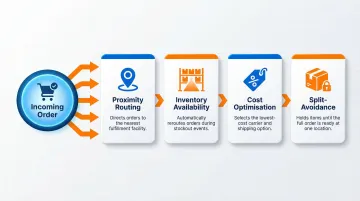
Strategic inventory placement and automated routing yield massive dividends. Brands using distributed inventory programmes experience a 15% reduction in shipping zones and can reduce fulfilment costs by over £1.50 per order.
Shipping Carrier Integrations
Native integrations with major carriers eliminate manual data entry and drive cost savings through real-time rate comparison.
Look for platforms offering:
- Multi-carrier support including Royal Mail, DPD, DHL, UPS, and FedEx
- Automated rate shopping that compares real-time carrier rates and selects the most cost-effective option
- Label generation with automatic address validation
- Tracking synchronisation that updates customers without manual intervention
Multi-carrier integration unlocks 80-90% carrier discounts and prevents bottlenecks when a single carrier experiences delays or capacity constraints.
Returns Management
Reverse logistics is often overlooked during software evaluation, yet it's critical for protecting margins. Total returns for the retail industry are projected to reach £654 billion in 2025, with 19.3% of online sales being returned.
The scale of the problem compounds beyond volume: 93% of retailers report that fraud and exploitative behaviour is a significant issue.
Good fulfilment software handles:
- Return authorisation workflows that validate return eligibility before issuing labels
- Condition assessment to determine whether items can be restocked, refurbished, or written off
- Automated restocking that returns inventory to available stock once validated
- Fraud detection that flags patterns indicating bracketing or empty-box returns
Reporting and Analytics
The right fulfilment data tells you where orders are slowing down, which carriers are underperforming, and when to adjust staffing before problems compound. Look for dashboards that track:
- Fulfilment speed — median time from order placement to shipment
- Order accuracy rate — percentage of orders shipped without errors
- Carrier performance — on-time delivery rates by carrier and service level
- Peak-period throughput — orders processed per hour during high-volume periods
- Returns rate by product — identifying quality issues or listing inaccuracies
Real-time dashboards enable operations teams to identify bottlenecks, adjust staffing, and make faster decisions without waiting for end-of-week reports.
Integration with Your Existing Tech Stack
Compatibility with ecommerce platforms (Shopify, WooCommerce, BigCommerce), ERPs, and CRMs is a baseline requirement. Rigid integration limits are a common pain point that creates expensive workarounds.
Evaluate:
- Native integrations vs. third-party middleware (native is faster and more reliable)
- API access and whether it's included or costs extra
- Sync frequency — real-time vs. batch updates
- Customisation flexibility for unique data mappings
Mid-market distributors using a "best-of-breed" strategy often encounter an "integration tax" consuming £30,000 to £92,000 annually in API maintenance, troubleshooting, and manual data reconciliation.
Fulfilment Software Pricing: What to Expect
Common Pricing Models
Fulfilment software vendors use several pricing structures, each suited to different business sizes and operational models:
- Per-order fees: A fixed fee per shipment processed. ShipStation's Starter plan runs £11.50/month for 50 shipments, scaling to £269/month for 10,000. Works well at low volumes, but costs compound quickly as you grow.
- Monthly SaaS subscriptions: Mid-market cloud WMS pricing typically starts at £1,500/month and reaches £7,700/month for larger operations. Core features are usually included, but additional users, locations, and integrations cost extra.
- Usage-based tiers: Costs scale with transaction volume, storage, or API calls. Watch for unpredictable bills during seasonal spikes.
- Enterprise licensing: Custom contracts negotiated after extensive scoping. Pricing is undisclosed and sales cycles are typically lengthy.
Hidden Costs Buyers Often Miss
Comparing base subscription fees provides an incomplete picture of Total Cost of Ownership (TCO). Budget for these frequently overlooked expenses:
| Hidden Cost Category | Typical Price Range | Operational Context |
|---|---|---|
| Implementation & Setup | £7,700 - £115,000 | Varies based on system complexity, custom workflows, and training |
| Data Migration | £3,800 - £38,000 | Depends on data quality and source system complexity |
| API & Integration Fees | £385 - £1,540+ | One-time API access fees, plus ongoing monthly support charges |
| Additional User Licences | £38 - £154/user/month | Costs scale rapidly as warehouse headcount grows |

Self-Operated Software vs. 3PL Service Pricing
Many buyers confuse pricing for standalone fulfilment software (which you operate internally) with 3PL fulfilment service pricing (where the 3PL charges for storage, pick-and-pack, and shipping separately).
Total 3PL costs typically range from £4.60 to £9.20 per order for standard ecommerce products, broken down roughly as:
- Pick and pack labour: £0.75 – £2.30
- Materials: £0.75 – £1.50
- Shipping: £3.00 – £5.40
Growing operations that invest in their own fulfilment software can optimise labour and carrier rates directly, often pushing per-order costs below these 3PL benchmarks.
Calculating Total Cost of Ownership (TCO)
To compare options on equal footing, calculate TCO over 3-5 years:
TCO Formula: Software subscription + Implementation + Integrations + Training + Ongoing support + Hidden fees
Example TCO Calculation (Mid-Market Operation):
- Monthly subscription: £2,300 × 36 months = £82,800
- Implementation: £23,000
- Data migration: £7,700
- API integrations (3 systems): £4,600
- Training (10 users): £3,800
- Annual support (15% of subscription): £12,420
- 3-Year TCO: £134,320
Run this calculation before shortlisting vendors — a lower monthly fee can easily become the more expensive option once implementation and integration costs are factored in.
How to Read Fulfilment Software Reviews: What Actually Matters
Which Review Signals Are Most Reliable
Individual complaints don't reveal much—every platform has frustrated users. Instead, look for consistent themes across multiple reviews that indicate systemic issues.
Prioritise reviews mentioning:
- Customer support responsiveness — how quickly the vendor resolves critical issues
- Peak-volume performance — whether the system handles Black Friday or seasonal spikes without crashing
- Implementation accuracy — whether the vendor delivered on promised timelines and functionality
One-off complaints about specific features often reflect unique use cases rather than fundamental platform limitations.
Review Categories That Matter Most for Operations Teams
When evaluating fulfilment software, focus on these four operational areas:
- Integration reliability — smooth API connections or months of troubleshooting? This directly affects your go-live timeline and ongoing maintenance burden
- Reporting quality — can users extract data without resorting to manual spreadsheet exports? Look for customisable dashboards, scheduled reports, and real-time visibility
- Uptime during peak periods — server delays and bugs during high-volume events cost real money; repeated downtime mentions point to infrastructure problems
- Pace of bug fixes and updates — vendors who ship fixes quickly show investment in the product; stagnant roadmap complaints mean you inherit limitations permanently
Common Red Flags in Reviews
Certain review patterns signal serious problems that will compound as you scale:
- Implementation overruns — if multiple reviews describe 6-12 month go-lives when the vendor promised 8-12 weeks, that gap is a pattern, not an exception. Cloud SaaS implementations typically run 8-12 weeks; complex enterprise suites stretch to 6-18 months
- Poor API documentation — incomplete or outdated docs mean your team spends time troubleshooting integrations rather than building useful functionality
- Forced process changes — reviews stating "the software made us change how we work" indicate a rigid platform that prioritises its own architecture over your workflows
- Data lock-in — difficulty exporting data or switching platforms points to proprietary formats designed to keep you captive, not to serve your operations
Common Limitations of Off-the-Shelf Fulfilment Software
The Rigidity Problem
Most fulfilment software is built for the average use case, which means businesses with non-standard workflows face constant friction. A staggering 77% of supply chain executives admit their automation infrastructure lacks the flexibility needed to respond quickly to unforeseen changes.
This rigidity carries a direct financial cost: 60% of executives with rigid systems took on additional operating costs or losses of 11% to 25% when responding to disruptions. The industries hit hardest are those with the most specific requirements:
- Regulated sectors (pharmaceuticals, healthcare) requiring FDA 21 CFR Part 11 compliance with validated systems and documented chain-of-custody
- Complex kitting operations where dynamic product bundling requires software to translate a single "kit" SKU into multiple individual pick tasks
- Multi-country operations managing diverse compliance requirements like ZATCA e-invoicing in Saudi Arabia and distinct VAT rules across the EU
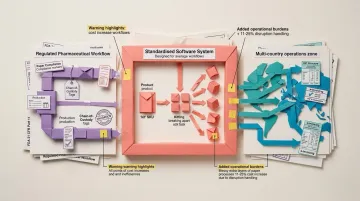
When software cannot adapt to new pick strategies or storage rules, warehouse staff bypass the system entirely with manual workarounds, leaving expensive software unused while teams revert to spreadsheets and paper logs.
The Scaling Ceiling
Many tools work well at low order volumes but buckle under real growth. Platforms designed for 500 orders daily often hit a wall at 2,000+, forcing expensive upgrades or a full platform swap.
Common scaling problems include:
- Per-order fees that compound quickly as volume grows
- Slow performance during peak periods as concurrent users overwhelm the system
- Licence costs that climb with every new warehouse hire
- Storage tier upgrades triggered by routine data growth
Most operations teams end up switching platforms within 2-3 years. That means a fresh round of data migration, staff retraining, and downtime — at exactly the moment the business needs stability.
The Integration and Ownership Problem
Rigidity and scaling limits compound a third problem: you don't actually own your data or your workflows. When you need a new feature or workflow adjustment, you're at the mercy of the vendor's development schedule.
Additional ownership challenges include:
- Limited API access restricting how you can extract or manipulate your own data
- Inability to customise workflows beyond pre-built configuration options
- Vendor-controlled infrastructure where you can't optimise database queries or server performance
- Opaque algorithms for inventory allocation or order routing that you can't inspect or modify
When a Custom Operations Platform Makes More Sense
The Profile of a Business Outgrowing Off-the-Shelf Tools
Certain operational profiles signal that off-the-shelf fulfilment software will become a constraint rather than an enabler:
- Complex workflows: Regulated compliance requirements, multi-step approvals, or dynamic kitting force manual workarounds that cancel out automation benefits
- Rapid iteration needs: Operations teams that adjust routing rules and optimise processes weekly can't afford to wait months for vendor feature requests to be prioritised
- Deep integration requirements: Custom data models, proprietary ERPs, or industry-specific tools create expensive middleware dependencies when forced through rigid pre-built connectors
- Full data ownership: Regulated industries need complete control over data models, audit trails, and system logic — not black-box platforms managed by a vendor
Keel: A Code-First Operations Platform for Custom Fulfilment
Keel is a code-first operations platform that lets operations teams launch tailored fulfilment systems in weeks, own their data, and scale on serverless infrastructure — without the bloat of legacy enterprise systems.
Founded by three former executives from Echo (Europe's fastest-growing online pharmacy, later acquired by Pharmacy2U), Keel emerged from direct experience with the limitations of off-the-shelf software.
Whilst scaling Echo to $130 million annual revenue — shipping 50,000 medicines to 600,000 customers daily — the founders found that generic tools were inflexible, couldn't meet the demands of a regulated pharmacy environment, and forced the team to build extensive custom software simply to keep operating.
How Keel Differs from Traditional Fulfilment Software:
Keel provides the foundational infrastructure for operators to construct fulfilment systems that mirror their specific processes. Rather than forcing operations to conform to software constraints, Keel enables fulfilment workflows to be designed from first principles using an intuitive schema language that becomes the source of truth for your entire system.
The platform offers pre-built base modules for order management, fulfilment, and warehouse management that can be shaped exactly around your processes, workflows, and complexity. Companies like HIVED and Bravely use Keel to power their operations, building sophisticated fulfilment systems that would be impossible with rigid off-the-shelf tools.
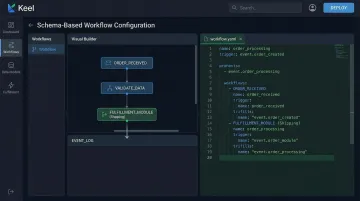
Key Capabilities:
- Launch tailored systems in weeks instead of months
- Own and control your data with custom data models
- Integrate with existing tools via strongly typed APIs
- Scale reliably on serverless infrastructure
- Version controlled with full local development experience
- Built-in authentication, permissions, observability, and audit trails
The Trade-Off: Control vs. Convenience
Custom-built operations software requires some technical involvement upfront — a developer with basic TypeScript knowledge — but that delivers total control, full auditability, and the ability to evolve workflows as the business changes.
What You Gain:
- Complete agility to launch, test, and evolve workflows without months of dev work
- Total ownership of your operations software and data
- Ability to iterate rapidly on complex logic without vendor dependencies
- Full visibility into system behaviour through complete audit trails
That control comes at a cost worth knowing upfront:
What You Trade:
- Immediate plug-and-play convenience of pre-built SaaS tools
- Vendor-managed feature roadmap (you own your roadmap instead)
- Point-and-click configuration (replaced by code-first schema definition)
For operations teams running complex workflows, this trade-off means you stop retrofitting your business to someone else's software — and start building tools that fit how you actually work.
Frequently Asked Questions
What does fulfilment mean?
Fulfilment refers to the complete process of receiving, processing, and delivering customer orders—covering everything from inventory management and order picking to packing, shipping, and returns handling. Every step between a customer placing an order and receiving their product falls within this scope.
What is fulfilment software used for?
Fulfilment software automates and manages the operational steps between receiving an order and delivering it to the customer. This includes inventory tracking across multiple locations, order routing to optimal fulfilment centres, shipping label generation with carrier rate comparison, and returns processing with restocking workflows.
How much does fulfilment software typically cost?
Pricing varies widely by model and scale, from low monthly fees for basic SaaS tools handling a few hundred orders to several thousand pounds a month for enterprise warehouse management systems. UK buyers should check whether quotes are in GBP or USD and whether VAT is added, and budget for implementation, integrations and ongoing support beyond the headline subscription to understand the true total cost of ownership.
What is the difference between fulfilment software and a WMS?
A warehouse management system (WMS) focuses specifically on in-warehouse operations including directed put-away, wave picking, and barcode scanning. Fulfilment software covers a broader scope—order management, multi-channel inventory sync, shipping carrier integrations, and customer-facing processes like tracking and returns—often incorporating basic WMS functionality within a wider platform.
What should I look for in fulfilment software reviews?
Look for consistent patterns around integration reliability, support quality, and performance at scale—not isolated complaints or star ratings alone. Reviews that mention peak-volume handling, implementation timelines, and support responsiveness tend to reveal the most about how a product actually performs in production.
When should a business consider building custom fulfilment software?
Businesses with complex or non-standard fulfilment workflows, regulated industries requiring validated systems, or rapid growth trajectories often find off-the-shelf tools too rigid. At that point, a code-first operations platform like Keel gives teams direct ownership of their workflows—so they can iterate on their own terms rather than waiting on vendor roadmaps.
What's the difference between 'fulfilment' and 'fulfilment'?
Both are correct — 'fulfilment' is the US spelling and 'fulfilment' is the UK and Commonwealth spelling of the same word. UK buyers researching fulfilment software will see both spellings depending on whether a vendor is US-based or UK-focused; the underlying process (receiving, picking, packing, shipping and returns) is identical either way.
Does my Amazon fulfilment model affect VAT registration in the UK?
It can. Depending on how and where you fulfil orders — for example using Fulfilment by Amazon (FBA) with stock held in the UK or EU — you may need to register for VAT in more than one country. This is a tax question for your accountant or HMRC, not something fulfilment software itself resolves; check GOV.UK and Amazon's own VAT guidance before choosing a fulfilment model.
Is Keel's fulfilment software billed in GBP?
Yes. Keel is billed in GBP as one fixed yearly subscription, with VAT added — a lot less than the cost of a traditional ERP or 3PL software module. Contact us and we'll price it against your fulfilment workflows and integrations.