Introduction
If you run a UK manufacturing business, you probably know the pattern: works orders printed from one system, stock tracked in a spreadsheet, batch records on paper, and the accounts in Sage or Xero. It holds together until volumes rise, a customer asks for full traceability, or an audit lands.
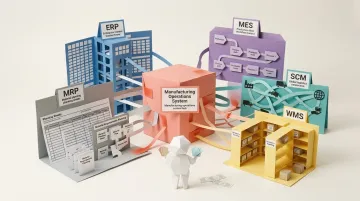
Manufacturing software is meant to join that up. The hard part is choosing the right type. ERP, MRP, MES, WMS and QMS each solve different problems, and picking ERP when you need MES, or a full enterprise system when a focused MRP would solve most of your pain, commits you to months of implementation and consulting fees for a system that still doesn't fit.
This guide explains the main types of manufacturing software and manufacturing management systems, compares leading solutions including options popular with UK SMEs, sets out UK-specific checks such as traceability, UKCA documentation, VAT and UK GDPR, and gives you a framework for choosing with confidence.
Key Takeaways
- Manufacturing software covers ERP, MES, MRP, SCM, WMS, and QMS—each solving distinct challenges at different operational layers
- The right fit depends on your manufacturing mode, business size, regulatory environment, and how much flexibility your team needs
- SAP S/4HANA and Epicor Kinetic suit large and mid-market manufacturers with complex, established processes
- Fast-moving teams increasingly favour flexible, custom platforms that launch in weeks—not months
- Total cost of ownership typically runs 1–2× the licence fee—budget well beyond the sticker price
- Small and mid-sized UK manufacturers often shortlist MRPeasy, Sage X3, The Access Group or Khaos Control before enterprise ERPs; check batch traceability, UKCA or CE documentation support and Making Tax Digital-ready finance links
- Vendor pricing for manufacturing ERP is mostly quote-based in the UK, so get a written total cost in £ covering licences, implementation, training and integrations
What Is Manufacturing Software?
Manufacturing software refers to any digital platform that helps plan, control, monitor, or optimise production and related business processes—spanning raw material procurement through final product delivery. It's a broad category covering dozens of tool types, each targeting a different layer of the business: procurement, production, quality, logistics, and finance.
As manufacturing environments grow more complex, centralising operational data and automating workflows has become a genuine competitive factor. The main benefits are:
- Real-time visibility of orders, stock and production progress
- Inventory and raw materials control, with fewer shortages and less excess stock
- Quality control built into production rather than checked afterwards
- Less downtime, through better scheduling and maintenance planning
- Better decision making, from reliable production and cost data
- Traceability from raw material batches to finished goods and customers
That scale reflects real demand. Most operations teams aren't struggling to find software; they're struggling to find software that actually fits how they work.
This guide breaks down the main types, what each one does well, and how to match them to your specific needs.
The Five Main Types of Manufacturing Software
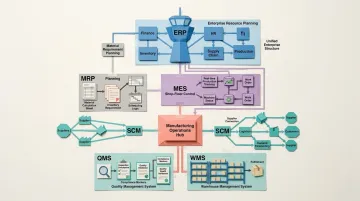
Before comparing specific platforms, it helps to understand how the major software categories differ. Each type solves a distinct problem—some operate at the business level, others on the shop floor, and several are commonly layered together.
ERP (Enterprise Resource Planning)
The most comprehensive category—ERP connects finance, inventory, production, HR, order management, and supply chain in a single platform. Designed to serve as one unified system of record across the entire business, ERP is the default choice for mid-to-large manufacturers who need cross-functional visibility.
For UK manufacturers, the ERP's finance module, or the accounting package it connects to such as Sage or Xero, is also usually where VAT records for Making Tax Digital are kept.
MES (Manufacturing Execution System)
Shop-floor focused software that monitors and controls production in real time—tracking machine status, work orders, operator activity, and quality events. MES bridges the gap between business-level ERP data and what's actually happening on the factory floor.
Positioned at Level 3 in the ISA-95 standard, MES sits between ERP (Level 4) and process control systems (Level 2), typically deployed alongside ERP rather than as a replacement.
MRP (Material Requirements Planning)
A narrower planning system focused on calculating what materials are needed, in what quantities, and when—based on production schedules and current inventory. The conceptual predecessor to ERP, MRP remains a practical option for smaller manufacturers with focused production planning needs and limited budget for a full ERP rollout.
SCM (Supply Chain Management Software)
Manages the flow of goods, information, and payments from suppliers through to customers. SCM tools provide visibility into supplier performance, lead times, logistics, and demand forecasting—often available as a standalone system or integrated as a module within ERP platforms.
WMS and QMS (Warehouse and Quality Management Systems)
These two systems are typically deployed as specialist modules integrated with ERP:
- WMS (Warehouse Management System) — optimises storage, picking, packing, and fulfilment operations
- QMS (Quality Management System) — enforces quality standards through inspections, non-conformance tracking, and regulatory documentation
Both extend core ERP functionality rather than replacing it.
Top Manufacturing Software Examples by Type
The five examples below represent leading solutions across core manufacturing software categories, selected based on market presence, operational depth, and suitability for distinct business profiles.
SAP S/4HANA
Background: SAP S/4HANA is the flagship ERP for large enterprise manufacturers, built on SAP's in-memory HANA database platform and available in cloud, on-premise, and hybrid deployments. It has governed manufacturing enterprises globally for decades and remains the dominant system for large, multi-site, or multinational operations.
Differentiators: Key strengths include:
- SAP Joule, an embedded AI assistant, automates decisions within existing workflows using natural language commands
- Deep compliance and regulatory capabilities suit highly regulated industries — pharma, automotive, and chemicals
- Breadth of vertical modules means minimal customisation for complex industry-specific processes
- Implementation costs and timelines are substantial; best suited to organisations with resources for a full rollout
| Feature | Details |
|---|---|
| Best For | Large enterprise manufacturers with global and multi-site operations |
| Deployment Options | Cloud, on-premise, hybrid |
| Pricing | Quote-based; implementation is a substantial project, so request a full cost estimate |
Epicor Kinetic
Background: Epicor Kinetic (formerly Epicor ERP) is widely considered the benchmark mid-market manufacturing ERP, with deep capabilities across discrete manufacturing modes including job shop, make-to-order, and engineer-to-order. It serves over 4,500 manufacturers across industries such as automotive, aerospace, and electronics.
Differentiators: - Consistently high customer retention signals strong operational fit for mid-market manufacturers
- Shop floor control and production scheduling tools are purpose-built for complex discrete manufacturing
- Supports cloud and on-premise deployment, giving manufacturers infrastructure flexibility
- Often used as the reference system when benchmarking competitors during ERP selection
| Feature | Details |
|---|---|
| Best For | Mid-market discrete manufacturers (job shop, make-to-order, engineer-to-order) |
| Deployment Options | Cloud, on-premise |
| Pricing | Quote-based; request user and implementation pricing from Epicor or a UK partner |
DELMIAworks
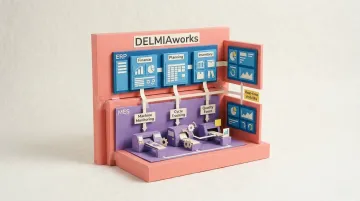
Background: DELMIAworks (formerly IQMS) takes a unique single-vendor approach that combines ERP and MES capabilities in one integrated platform—eliminating the need to separately procure and integrate shop-floor monitoring alongside business management tools. Acquired by Dassault Systèmes for $425 million in 2018, it's purpose-built for process manufacturing environments where real-time production visibility is critical.
Differentiators: Unified ERP and MES architecture means production data flows directly into financial and planning modules without middleware — particularly strong for plastics, rubber, and automotive manufacturers.
Real-time shop floor dashboards give operations managers live visibility into machine utilisation, cycle times, and quality events without additional infrastructure investment.
| Feature | Details |
|---|---|
| Best For | Process manufacturers needing real-time shop floor control integrated with ERP |
| Deployment Options | Cloud, on-premise |
| Pricing | Quote-based |
NetSuite ERP
Background: Oracle NetSuite is a cloud-native ERP widely adopted by fast-growing manufacturers and distributors who need an integrated platform covering financials, inventory, order management, and supply chain without the infrastructure overhead of on-premise systems. Its SaaS model and modular architecture make it accessible to growing businesses through to the mid-enterprise range.
Differentiators: - Implementation timelines of 4–9 months — faster than SAP or Oracle on-premise equivalents
- Native integrations with e-commerce platforms suit manufacturers selling direct-to-consumer
- Modular scalability lets businesses add functionality as needs grow, without a full system replacement
| Feature | Details |
|---|---|
| Best For | Fast-growing SMB to mid-market manufacturers, D2C and e-commerce-driven manufacturing businesses |
| Deployment Options | Cloud-only (SaaS) |
| Pricing | Quote-based: annual subscription for the base platform plus users and add-on modules |
Keel
Background: Keel is a code-first operations platform built as a modern alternative to legacy ERP — designed for operations teams that need total ownership, custom data models, and the ability to launch tailored internal tools in weeks rather than months. Founded by the former CEO, CTO and CPO of Echo — Europe's fastest growing online pharmacy, later acquired by Pharmacy2U, where they built custom software to run operations shipping 50k medicines to 600k customers daily and grew the business to $130m annual revenue — Keel was built from direct experience of legacy software failing to keep pace with fast-moving, regulated operations.
Differentiators: - Schema-driven architecture lets teams define their own data models and business logic — no vendor-dictated workflows
- Built-in authentication, audit trails, permissions, and serverless infrastructure deliver a production-grade system teams can iterate on continuously
- Bridges the gap between spreadsheets and legacy ERP for businesses that have outgrown no-code tools but don't need full enterprise overhead
- Production management built around your process: production batches matched to orders and delivery, scheduling, QC checkpoints in the flow, and traceability from raw materials through to finished goods
| Feature | Details |
|---|---|
| Best For | Fast-moving operations teams, businesses in regulated industries, companies outgrowing no-code tools or spreadsheets |
| Deployment Options | Fully managed serverless infrastructure with multi-region data residency (choose where data is hosted, including the UK), or self-hosting |
| Pricing | One fixed yearly subscription; contact Keel for prices |
How to Choose the Right Manufacturing Software
Map Your Operation Before Evaluating Vendors
The most common and costly mistake in software selection is starting with vendor demos before documenting operational requirements. Define your manufacturing mode (discrete, process, make-to-order, make-to-stock), regulatory constraints, team structure, and integration requirements first. The software type should follow the operational profile, not the other way around.
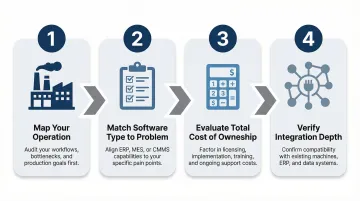
Match Software Type to Problem, Not Budget
ERP is not the default answer for every manufacturing challenge. A standalone WMS or MES may resolve 80% of the operational pain at a fraction of the cost and implementation complexity. Selecting the correct software category before shortlisting vendors is the most effective way to avoid over-investing in unused features.
Evaluate Total Cost of Ownership Beyond the Licence Fee
For enterprise and mid-market ERP systems, implementation, data migration, training, and customisation costs exceed the initial software licence. Panorama Consulting's 2025 ERP Report, a global survey reported in US dollars, puts the median ERP project cost at $450,000, with implementation services typically costing 1 to 2 times the annual software licence fees. More than a quarter of organisations exceed their project budgets.
When building your budget, account for the full project lifecycle — not just the licence.
Prioritise Flexibility and the Ability to Iterate
Manufacturing operations change — new product lines, evolving workflows, shifting compliance requirements — and the software must keep pace. Assess whether the vendor charges for customisations, how long changes take to deploy, and whether the team retains true ownership of their processes.
For teams that need to move fast, Keel offers version-controlled, schema-driven customisation that reduces dependency on external consultants for every workflow update.
Verify Integration Depth with Existing Tools
Confirm the shortlisted software connects natively with your existing stack — WMS, CRM, e-commerce platform, IoT sensors, or EDI systems — without requiring expensive middleware or custom API work. Poor integration is one of the leading causes of ERP implementation failure, with unexpected integration needs cited as the top cause of budget overruns.
Integration architecture deserves its own budget line and its own workstream — scoped before go-live, not cleaned up after.
Conclusion
The right manufacturing software matches your operational complexity, growth stage, and the level of control your team actually needs — not just the most recognised name on the market.
Before committing, assess:
- Total cost of ownership — licensing, implementation, and ongoing maintenance
- Integration depth — how well it connects with your existing tools and data
- Long-term flexibility — whether you can adapt it as your operations evolve
For teams who have outgrown spreadsheets and no-code tools but don't need the overhead of a full legacy ERP, platforms like Keel offer a faster route to owning and controlling your own operations systems — without months of custom development.
Explore Keel's operations platform or reach out to the team at hello@keel.so to discuss your specific operational requirements.
Frequently Asked Questions
What is the best manufacturing software?
There is no single best option; the right software depends on manufacturing mode, business size and how much flexibility you need. ERP such as SAP S/4HANA or Epicor Kinetic suits complex, cross-functional operations, MES fits shop-floor focus, and small UK manufacturers often start with MRPeasy, Sage or The Access Group. Modern platforms like Keel suit teams that need custom, owned workflows.
What are the five types of software used in manufacturing?
The five key categories are ERP (enterprise-wide integration), MES (shop-floor execution), MRP (materials planning), SCM (supply chain management), and WMS/QMS (warehouse and quality management). ERP often serves as the integration layer connecting the others.
What is the difference between MRP and ERP software?
MRP focuses specifically on materials planning and production scheduling based on inventory and demand. ERP is a broader platform covering financials, HR, customer management, and operations—making ERP effectively a superset of MRP functionality.
How much does manufacturing software typically cost?
Costs vary widely with the software type, number of users and scope. Cloud MRP tools for small manufacturers are usually priced per user per month, while mid-market and enterprise ERP is mostly quote-based and implementation projects are substantial. Implementation services typically cost 1 to 2 times the annual licence fee, so ask vendors for a written total cost in £, including training and integrations, and confirm whether VAT is included.
What is a manufacturing execution system (MES)?
MES software manages and monitors production operations in real time on the shop floor—tracking machine status, work orders, operator activity, and quality data. Positioned at Level 3 in the ISA-95 standard, it's typically deployed alongside ERP to connect planning data with what's physically happening in production.
What is manufacturing software?
Manufacturing software is any system that helps a manufacturer plan, run and control production and the processes around it, from buying raw materials to shipping finished goods. The main types are ERP, MRP, MES, supply chain management, warehouse management and quality management software. UK manufacturers often combine one of these with an accounting package such as Sage or Xero.
What is a manufacturing management system?
A manufacturing management system is software that runs the production cycle: planning and scheduling, bills of materials, work orders, purchasing raw materials, shop floor data collection, quality control and traceability. It can be an MRP system, the manufacturing modules of an ERP, or a dedicated production management platform, depending on the size and complexity of your operation.
What is the best manufacturing software for small UK manufacturers?
It depends on your production type and budget, but small UK manufacturers commonly shortlist MRPeasy (built for manufacturers with up to 200 employees), The Access Group, Khaos Control and Sage's manufacturing products. Prioritise ease of use, batch traceability, a link to your accounting software for Making Tax Digital, and UK support, and trial the system with real works orders.
What's the difference between a manufacturing add-on and a dedicated manufacturing platform?
A manufacturing add-on extends your accounting software with BOMs, work orders and stock control, so it is quick and affordable but limited in scheduling, quality and traceability. A dedicated manufacturing platform is built around production itself and goes deeper on the shop floor, usually connecting to finance separately. Choose an add-on for simple production and a dedicated platform when production complexity drives your business.
Does manufacturing software help with UKCA marking?
Manufacturing software doesn't give you UKCA marking, but a quality management system or document control module can hold the evidence you need: specifications, test results, technical files and declarations of conformity linked to each product version. Whether your products need UKCA or CE marking depends on the product type, so check the current rules on GOV.UK.
How does manufacturing software support product recalls in the UK?
By recording batch or lot numbers at every step, manufacturing software can trace a faulty component to every finished product and customer that received it, and produce that list quickly. Look for forward and backward traceability, quarantine or hold status for suspect stock, and exportable reports you can share with customers, insurers or regulators.