
Introduction
A Yorkshire food manufacturer imports packaging from the Netherlands, buys ingredients from UK growers in pounds and from EU suppliers in euros, and sells to supermarkets that expect accurate delivery dates. Purchase orders sit in email, stock in a spreadsheet, and VAT and customs paperwork in the accounting package. When a supplier is late, nobody sees the knock-on effect until a delivery is missed.
That is the problem ERP software for supply chain management is meant to solve. Enterprise resource planning (ERP) connects planning, procurement, inventory, production, fulfilment and finance in one shared system, so every team works from the same live data. For UK operations teams it also has to cope with UK specifics: VAT and Making Tax Digital, customs declarations for EU trade, suppliers in several currencies and UK GDPR.
This guide explains what ERP does across the supply chain, how it differs from SCM software, the benefits that show up in day-to-day KPIs, and what UK buyers should check.
Key Takeaways
- ERP provides a unified, real-time view of data across procurement, inventory, production, and fulfilment—replacing disconnected tools and manual processes
- The three most operationally significant benefits are end-to-end visibility, process automation, and inventory optimisation—each with direct impact on cost, speed, and reliability
- Without ERP, supply chains default to reactive firefighting with siloed data, manual errors, and compounding bottlenecks
- ERP drives real value only when it actively shapes decisions, not just stores data
- ERP runs your own operations and finance end to end; SCM software (WMS, TMS, supply chain planning) goes deeper into the supplier and logistics network
- UK buyers should test supply chain ERP against VAT and Making Tax Digital, EU customs and landed costs, multi-currency suppliers and UK GDPR data hosting
What Is ERP in Supply Chain Management?
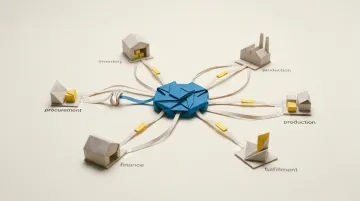
ERP is a software system that connects the core functions of a business—procurement, inventory, production, fulfilment, and finance—in a single shared database, so every team works from the same real-time information. There's no manual consolidation, no version conflicts, no waiting for someone to update a spreadsheet.
In supply chain management, ERP acts as the operational backbone — linking demand planning, supplier management, warehouse operations, and order management into one coordinated system. That real-time connectivity has direct operational consequences:
- When procurement updates a supplier order, planning, warehouse, and finance teams see that change immediately
- When inventory levels shift, production scheduling adjusts accordingly
- When a fulfilment delay occurs, downstream teams can respond before it becomes a customer problem
That's the core value of ERP in a supply chain context: shared data that keeps every function aligned, without the manual handoffs that slow decisions down.
Key Benefits of ERP in Supply Chain Management
The benefits below focus on measurable operational outcomes—the kind operations leaders track in day-to-day performance reviews, not theoretical gains on paper.
End-to-End Visibility and Faster Decision-Making
Visibility in this context means a single, live view of every stage of the supply chain—from supplier lead times and purchase orders through to inventory levels, production status, and outbound delivery—accessible across teams without manual data consolidation.
ERP creates this visibility by storing all supply chain data in one shared system, eliminating the lag and inconsistency that comes from pulling data out of separate tools or spreadsheets. Changes made by one team (procurement updating a supplier order, for example) are immediately reflected for planning, warehouse, and finance teams.
Why this is an advantage:
Decisions made on stale or incomplete data are one of the most common causes of supply chain failure—late reorders, overstocked lines, missed delivery windows. Currently, 65% of procurement leaders have limited or no visibility beyond their Tier-1 suppliers, creating costly operational blind spots. Over a quarter of organisations estimate they lose more than $5 million annually due to poor data quality, with 7% reporting losses of $25 million or more.
When planners can see actual inventory, in-transit stock, and forecasted demand in one place, they can respond to disruptions in hours rather than days. Gartner reports that 95% of supply chains must quickly react to change, but only 7% can execute decisions in real time. Without real-time execution enabled by integrated systems, response is delayed even when teams know what to do.
KPIs impacted:
- Order fulfilment rate
- On-time delivery percentage
- Demand forecast accuracy
- Supplier lead time adherence
- Stockout frequency
When this advantage matters most:
Visibility becomes especially critical as supply chain complexity scales—more SKUs, more suppliers, more geographies, or higher order volumes—and when disruptions (supplier delays, demand spikes) require rapid cross-functional response.
Process Automation and Operational Efficiency
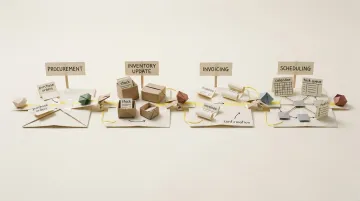
ERP automates the repetitive, rules-based tasks that typically require manual intervention in fragmented systems—things like purchase order generation when stock hits a reorder threshold, invoice matching, inbound goods receipts, and production scheduling updates.
Business rules and triggers are encoded directly into the system, so workflows move forward automatically without requiring an operator to chase information across teams or manually transfer data between tools.
Why this is an advantage:
Manual processes introduce two compounding costs—time and error. Human error rates in complex cognitive tasks such as spreadsheet data entry range from 1% to 5%, and over 60% of invoice errors are caused by manual data entry.
Fixing these mistakes is expensive: every exception pulls finance and purchasing staff away from value-added work while suppliers wait to be paid.
Automation doesn't just save time on individual tasks—it keeps the supply chain moving without bottlenecks caused by approval delays, missed alerts, or data re-entry mistakes that can cascade into production or delivery failures. Automated systems reduce labour requirements by 70-80% and process invoices 3 to 5 times faster than manual methods.
KPIs impacted:
- Processing time per order
- Error rate in purchase orders or inventory records
- Time-to-fulfilment
- Labour cost per transaction
- Manual intervention rate
When this advantage matters most:
Automation has the highest impact at volume—when order frequency, supplier interactions, and inventory transactions scale beyond what a small team can manage manually without errors. It's also critical in regulated industries where audit trails and process consistency are non-negotiable.
Inventory Optimisation and Cost Control
Inventory optimisation through ERP means holding the right quantity of stock at the right time—not over-ordering to compensate for uncertainty and not under-ordering and triggering stockouts—based on real demand signals, supplier lead times, and seasonal patterns.
Rather than relying on static par levels set months in advance, ERP combines live inventory data with demand forecasting, supplier lead time data, and reorder logic to calculate optimal stock levels dynamically.
Why this is an advantage:
Excess inventory ties up working capital and consumes warehouse space, while insufficient inventory leads to production stoppages and missed customer commitments. Inventory carrying costs consume 15% to 25% of inventory value, and stockouts cost the global economy $1.2 trillion annually.
The downstream impact is significant: a stockout loses the immediate sale and often the customer too, who may switch to a competing brand.
In Europe, Days Inventory Outstanding jumped 4% to 68.9 days, its highest level in a decade, as companies built inventory buffers to manage supply chain risks. Across US and European markets combined, the same survey found over $3.1 trillion trapped in excess working capital.
That scale of trapped capital reflects what happens when procurement decisions are disconnected from real demand data. ERP closes that gap—grounding reorder decisions in actual signals, which directly reduces waste, write-offs, and emergency purchases at premium cost.
KPIs impacted:
- Inventory turnover rate
- Carrying cost as a percentage of inventory value
- Stockout rate
- Days of supply
- Waste and write-off rates
- Working capital tied in inventory
When this advantage matters most:
This advantage is most significant for businesses with high SKU counts, seasonal demand variation, long supplier lead times, or tight margins where inventory inefficiency has an immediate P&L impact.
What Happens When ERP Is Missing from Your Supply Chain
Without ERP, the common operational reality is teams working from different versions of the same data—spreadsheets, email threads, disconnected tools—which means every cross-functional decision requires manual reconciliation and carries risk of error.
Despite massive digital transformation investments, 81.1% of professionals still rely on Excel or Google Sheets to manage Sales & Operations Planning. This fragmentation guarantees compounding consequences:
- Inconsistent demand signals lead to chronic over or under-ordering
- Manual processes create error-prone handoffs between procurement, warehouse, and fulfilment
- Stock problems surface too late — low inventory, delayed suppliers, and fulfilment backlogs are discovered reactively, after customers are already affected
- Operational costs accumulate unseen—admin overhead, corrective orders, and wasted warehouse space compound without a clear line of sight to the source
- What works at low volume breaks fast: the manual workarounds a five-person team manages comfortably fall apart when order volume doubles

Stockouts that take weeks to resolve and supplier disputes over mismatched order details aren't edge cases — they're the predictable cost of running operations without a single source of truth.
How to Get the Most Value from ERP in Your Supply Chain
ERP delivers its full value only when genuinely embedded in how the operations team works—not treated as a reporting tool checked monthly, but as the live system of record that every decision flows through in real time.
Three conditions under which ERP works best:
- Applied consistently across all supply chain functions—no shadow spreadsheets running alongside it
- Outcomes reviewed regularly against the KPIs it surfaces
- Flexible enough to evolve as workflows change—rigid systems that require months of development time to adjust become a bottleneck in themselves
That third condition is where many operations teams hit a wall. Legacy ERP systems lock you into vendor roadmaps, require expensive consultants for customisation, and treat implementation as a multi-year project rather than an iterative one. By the time a change is live, the workflow it was meant to support has already moved on.
Keel was built specifically to address this. Its founders were the CEO, CTO and CPO of Echo, Europe's fastest-growing online pharmacy (later acquired by Pharmacy2U), where they built custom software to run operations shipping 50k medicines to 600k customers daily and grew the business to $130m annual revenue. Keel gives supply chain teams ERP-level capabilities without the rigidity of legacy systems:
- Launch tailored workflows in weeks, not months
- Own and control your data model directly—no vendor lock-in
- Iterate as the business evolves without waiting for consultant availability or vendor release cycles
It's designed for teams that have outgrown spreadsheets and no-code tools and want to launch tailored systems in weeks instead of months, without doubling their budget for consultants.
Conclusion
ERP's value in supply chain management comes down to three practical outcomes:
- Visibility — clearer data for faster, more confident decisions
- Automation — fewer manual errors and lower operational overhead
- Inventory control — tighter cost management across the supply chain
Each advantage builds on the others. A team that can see its inventory accurately can automate replenishment sensibly; a team that automates well frees capacity to focus on the decisions that matter.
Treat ERP as an ongoing operational practice, not a one-time implementation. Its value grows as the business grows, as long as the system stays flexible enough to evolve alongside your operations — not lock them in place.
Frequently Asked Questions
What is ERP in supply chain management?
ERP (enterprise resource planning) in supply chain management is a software system that integrates core supply chain functions (procurement, inventory, production, order fulfilment and finance) into a single shared database, giving every team a unified, real-time view of operations. For UK businesses, that shared record also underpins VAT reporting, landed costs on imports and supplier management across currencies.
What are the main functions of ERP in supply chain management?
ERP supports demand planning, procurement, inventory management, warehouse operations, production scheduling, and order fulfilment. All of these functions operate within one coordinated system rather than across disconnected tools.
How does ERP improve supply chain visibility?
ERP centralises all supply chain data in one system, eliminating information silos between departments. Any team can see live inventory levels, order status, supplier performance, and production progress without manual data consolidation.
Which ERP is best for supply chain management?
The best ERP for supply chain management depends on your scale, processes and how much flexibility you need. Traditional enterprise platforms suit large, stable operations; modern alternatives like Keel are built for fast-moving teams that need data ownership and short implementation cycles. UK buyers should also compare VAT and MTD handling, multi-currency purchasing, data hosting options and GBP pricing before shortlisting.
What happens to a supply chain without ERP?
Without ERP, supply chains suffer from fragmented data, reactive decision-making, and higher error rates in procurement and fulfilment. Operational costs accumulate steadily as volume grows, making scaling both difficult and expensive.
Is the ERP system easy to learn?
Ease of adoption varies significantly by system. Legacy ERP platforms are often complex and require extensive training, while modern, purpose-built operations platforms are designed with fast-moving teams in mind and prioritise clean, intuitive interfaces that operators can use without deep technical expertise.
What does ERP stand for in supply chain management?
ERP stands for enterprise resource planning. In supply chain management it refers to software that connects planning, purchasing, inventory, production, order fulfilment and finance in one shared database. Instead of each department keeping its own spreadsheet, everyone works from the same live record of stock, orders and supplier commitments, which makes the supply chain easier to plan and control.
What is the difference between ERP and SCM?
ERP manages a business's internal operations and finance in one system, including procurement, inventory, production and accounting. SCM (supply chain management) software focuses on planning and moving goods across the wider supplier and logistics network, often through a WMS, TMS or planning tool. Many UK SMEs start with ERP covering the supply chain basics and add SCM tools as complexity grows.
What should UK businesses look for in supply chain ERP software?
UK businesses should look for supply chain ERP software that fits their processes and handles UK requirements: VAT on purchase and sales documents, data that feeds Making Tax Digital-compatible accounting, commodity codes and landed costs for EU trade, multi-currency suppliers, and a clear answer on where data is hosted under UK GDPR. Also check implementation time, integration with existing tools, GBP pricing and UK support.
Can an ERP system handle VAT and Making Tax Digital?
An ERP can record VAT on every purchase order and invoice, but check whether it files VAT Returns itself or passes data to accounting software that does. VAT-registered UK businesses must keep digital records and submit VAT Returns through MTD-compatible software. Keel's order management, for example, handles taxes on orders; check how that VAT data then reaches your MTD-compatible accounting software.
How does ERP help UK businesses importing from the EU?
ERP helps UK importers by holding commodity codes and country of origin against each product, and by capturing duty, freight and customs costs on purchase orders so landed cost and margins are accurate. Linking purchase orders, goods receipts and supplier invoices also makes customs paperwork easier to reconcile. The declarations themselves are usually handled by a customs broker or freight forwarder.
What is ERP fulfilment?
ERP fulfilment is the order-to-delivery part of an ERP: allocating stock to orders, picking, packing and shipping, selecting carriers and processing returns, with stock and finance updated automatically. For a detailed look at how it works and what to look for, see our guide to ERP fulfilment software.