Introduction
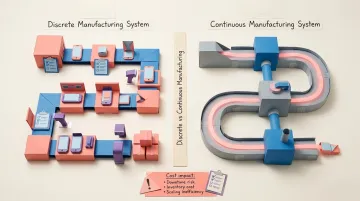
For a UK operations leader, 'continuous production' isn't an abstract term — it's whether your factory floor runs as a batch line assembling discrete units, or a continuous process running non-stop, because a UK beverage or biscuit plant running continuous flow looks nothing like a UK site assembling vehicle components job by job, yet both are called "manufacturing." Misaligning your workflow type with these operational decisions creates compounding inefficiencies that are hard to unwind.
The cost of getting this wrong is concrete. Unplanned downtime costs Fortune 500 manufacturers 11% of their annual revenue — $1.4 trillion globally. Discrete manufacturers wrestling with SKU proliferation see inventory carrying costs balloon to 15–25% of total inventory value annually.
This post defines continuous (flow) production and discrete manufacturing, sets out where each model fits, and explains why the two need fundamentally different production workflow software.
Key Takeaways
- Discrete manufacturing produces distinct, countable units — cars, electronics, furniture
- Continuous manufacturing runs uninterrupted flows with no individual units — chemicals, fuel, paper
- Continuous workflows prioritise uptime and throughput; discrete workflows trade some throughput for flexibility and product variants
- Your choice affects scheduling logic, inventory management, quality control methods, and the software your operations team needs
- Most businesses fall clearly into one category — hybrid models exist mainly in food, pharma, and specialty chemicals
- In the UK, continuous (flow) production is long-established in food and drink, chemicals and pharmaceutical manufacturing — sectors that are also core Keel target segments
- UK regulatory bodies such as the MHRA (medicines) and the Food Standards Agency (food) shape how continuous processes are validated and traced, alongside the ISA-88/ICH Q13 standards used for hybrid batch models
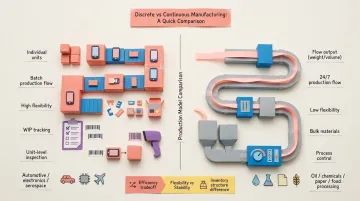
Discrete vs Continuous Manufacturing: A Quick Comparison
| Dimension | Discrete Manufacturing | Continuous Manufacturing |
|---|---|---|
| Output Type | Individual, countable units | Uninterrupted flow measured by weight/volume |
| Production Flow | Job-based or batch-based runs through workstations | 24/7 operation with raw materials in, finished product out |
| Flexibility | High—frequent changeovers, product variants | Low—standardised output, minimal changeovers |
| Inventory Approach | WIP tracking at unit level, batch numbers | Bulk raw materials, yield management |
| Quality Control | Unit-level inspection, traceability | In-line process monitoring, parameter control |
| Typical Industries | Automotive, electronics, aerospace, medical devices | Oil refining, chemicals, paper, bulk food processing |
Both models share the same core workflow stages—planning, scheduling, execution, monitoring, and control—but differ in how each stage is executed and what KPIs matter most. Discrete operations track individual work orders and job completion rates. Continuous operations monitor uptime percentages, yield rates, and throughput volume.
What is Discrete Manufacturing?
Discrete manufacturing produces individual, identifiable units that can be counted, inspected, and traced. Operations teams manage bills of materials (BOMs), work orders, and assembly sequencing to coordinate how components become finished goods.
Core Workflow Characteristics
Discrete workflows operate through job-based or batch-based production runs. Production moves through multiple workstations, with frequent machine setups and changeovers as teams switch between product variants or customer orders. Work-in-progress (WIP) inventory accumulates between stations, requiring careful tracking to prevent bottlenecks.
Each finished unit carries a unique identifier—serial number, batch code, or order reference—enabling complete traceability from raw materials through final assembly.
Operational Benefits
Discrete manufacturing delivers:
- High flexibility to accommodate product variants and custom orders without retooling entire production lines
- Unit-level traceability making quality inspection and recall management straightforward
- Ability to pause and resume production without major loss, allowing responsive scheduling
Key Challenges
Managing discrete workflows introduces complexity:
- SKU proliferation compounds scheduling difficulty — new variants drive lower order quantities, larger inventories, and added losses from retooling
- Material coordination requires precise synchronisation between procurement and production schedules to prevent shortages or excess WIP
- Workstation bottlenecks occur when one stage operates slower than others, creating accumulation points that tie up working capital
The scale of discrete production is significant globally; in the UK, manufacturing output data is published by the Office for National Statistics (ONS). The same complexity dynamics — SKU proliferation, changeover coordination — make robust workflow systems essential regardless of the specific output figures involved.
Use Cases of Discrete Manufacturing
Discrete workflows fit design-to-order, make-to-order, and assemble-to-order environments where each finished good is distinct and traceable.
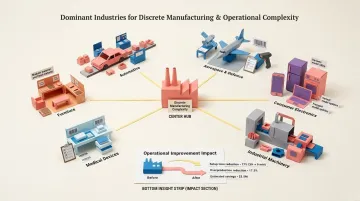
Dominant industries include:
- Automotive – Vehicles assembled from thousands of components with specific configurations per customer order
- Aerospace and defence – Aircraft, satellites, and military equipment requiring rigorous traceability and compliance documentation
- Consumer electronics – Smartphones, laptops, and appliances with multiple SKUs and frequent model updates
- Industrial machinery – Custom equipment built to specification with long lead times
- Medical devices – Regulated products requiring serialisation and complete manufacturing records
- Furniture – Made-to-order items with customer-selected materials and finishes
These industries share a common challenge: complexity compounds quickly. Schneider Electric's Tlaxcala plant in Mexico demonstrated what structured workflow improvement can achieve — implementing continuous flow and Single-Minute Exchange of Dies (SMED) in cabinet processing reduced setup time by 77% (from 39 to 9 minutes) and cut overproduction of stamped parts by 17.5%, yielding approximately US$3.5 million in savings.
What is Continuous Manufacturing?
Continuous manufacturing runs production processes without interruption, converting raw materials into a uniform output stream. Operations teams focus on uptime, yield rates, and in-line quality monitoring rather than individual unit tracking.
Core Workflow Characteristics
Continuous plants operate 24/7 or near-continuously. Raw materials feed in at one end, finished product extracts at the other, with minimal changeovers between production runs. Real-time process parameter control—temperature, pressure, flow rate—maintains output consistency.
Production doesn't stop for shift changes, breaks, or minor adjustments. The entire line runs as an integrated system where stopping one section affects everything downstream.
Operational Benefits
Continuous workflows deliver:
- High throughput volume that drives economies of scale and lower per-unit costs
- Fewer labour touchpoints through automation and integrated process control
- Consistent output quality when parameters remain stable, reducing variation
Key Challenges
Continuous operations face distinct pressures:
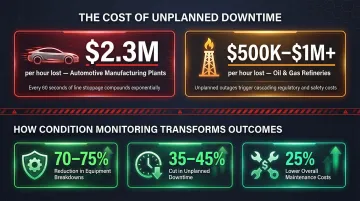
- Very high cost of downtime – Any stoppage affects the entire line. Automotive plants lose $2.3 million per hour, whilst oil refineries lose $500,000 to $1 million+ per hour
- Difficulty accommodating variation – Changing product specifications requires significant retooling and process parameter adjustments
- Complex regulatory compliance in industries like pharmaceuticals and food processing, requiring continuous documentation and validation
- Capital-intensive equipment with high upfront investment and specialised maintenance requirements
Condition monitoring reduces equipment breakdowns by 70–75%, cuts unplanned downtime by 35–45%, and lowers total maintenance costs by 25% — which is why predictive maintenance has become standard practice in continuous operations.
Use Cases of Continuous Manufacturing
Despite high capital costs and downtime risk, continuous workflows remain the default for high-volume commodity production where output is measured in weight, volume, or energy units rather than discrete pieces.
Dominant industries include:
- Oil refining and petrochemicals – Crude oil processed into fuels, plastics, and chemical feedstocks
- Bulk food and beverage processing – Dairy, brewing, soft drinks, and flour milling
- Paper and pulp – Continuous sheet production from wood pulp
- Cement and glass – High-temperature processes producing bulk building materials
- Pharmaceutical API production – Active pharmaceutical ingredients manufactured in continuous reactors
Case study — Shell: Shell deployed a predictive maintenance platform across 10,000 pieces of equipment globally (valves, compressors, pumps). The system achieved a 20% reduction in unplanned downtime and a 15% reduction in maintenance costs, translating to £1 million+ in annual savings per major site.
Discrete vs Continuous: Which Workflow Fits Your Operation?
Key Decision Factors
Choose your production model based on:
- Product type – Unit-based goods vs. bulk commodities
- Volume and variability – Customisation needs vs. standardised output
- Capital investment – Flexible equipment vs. dedicated process lines
- Regulatory environment – Unit traceability requirements vs. batch compliance
- Operational flexibility – Frequent product changes vs. long production runs
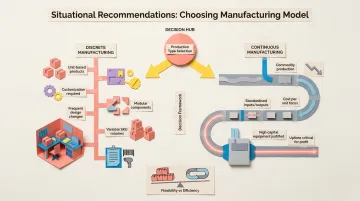
Situational Recommendations
Choose discrete manufacturing if:
- Your products are unit-based and require individual traceability
- Customers demand customisation or product variants
- Design changes occur frequently
- Production volumes vary significantly by SKU
- Regulatory requirements mandate serialisation
Choose continuous manufacturing if:
- You produce commodity volumes with standardised specifications
- Throughput and cost-per-unit are primary competitive factors
- Raw materials and outputs can be standardised
- Capital investment in dedicated equipment is justified by volume
- Uptime percentage directly determines profitability
The Hybrid Scenario
Some industries use elements of both models. Pharmaceutical manufacturing, specialty food production, and chemical blending often employ "batch manufacturing"—a hybrid approach defined by the ISA-88 standard as discontinuous processes that are "neither discrete nor continuous; however, they have characteristics of both".
Batch processes produce finite quantities by subjecting inputs to a defined order of processing actions. This creates unique workflow management challenges: teams must track batch identities like discrete manufacturing whilst maintaining process control like continuous operations.
The FDA and EMA recognise hybrid continuous manufacturing through ICH Q13 guidelines, which define hybrid modes as approaches where "some unit operations operate in a batch mode while others are integrated and operate in a continuous mode".
How Workflow Software Needs Differ
Discrete operations require:
- Work order management systems tracking job status and routing
- BOM tracking with component-level visibility
- Scheduling tools handling job sequencing and changeover coordination
- WIP inventory tracking across workstations
Continuous operations need:
- Real-time process monitoring dashboards
- Yield management and variance tracking
- Predictive maintenance integration
- Parameter control and alarm management
The software requirements for each model are genuinely different — and that's where generic ERP systems struggle. They impose standardised workflows instead of adapting to your actual process, making them a poor fit for both discrete and continuous operations.
Operations teams managing discrete workflows can build custom work order and production planning systems tailored to their exact process using a platform like Keel, without being constrained by rigid ERP logic or lengthy implementation timelines.
Real-World Examples
Discrete Manufacturing: Automotive Component Assembly
An automotive manufacturing plant implemented SMED (Single-Minute Exchange of Dies) on a spare parts assembly line to address lengthy changeover times that reduced production capacity. The methodology focused on separating internal setup activities (performed whilst machines are stopped) from external activities (performed whilst machines run).
The intervention reduced changeover time by 291.4 seconds per event, significantly increasing Overall Equipment Effectiveness (OEE) and projecting €5.87 million in savings over 5 years. Those gains came from three operational changes:
- Standardising tool locations to eliminate search time
- Pre-staging materials before machine stops
- Training operators on parallel setup tasks
Continuous Manufacturing: Pharmaceutical Production
Pfizer used Portable, Continuous, Miniature & Modular (PCMM) technology for the continuous direct compression of Daurismo (glasdegib) tablets. Traditional batch manufacturing would have required extensive scale-up studies, validation batches, and sequential process development.
The continuous manufacturing approach accelerated the NDA regulatory filing by more than 3 years compared to traditional batch timelines—three years that, in a regulated pharmaceutical market, translate directly to patient access and commercial advantage.
Take Control of Your Production Workflows
Both examples share a common thread: the teams that moved fastest were the ones with precise control over their own processes. Whether you're managing discrete job-based production or optimising a continuous process line, that control starts with the tools you build on. Keel enables manufacturing teams to build production planning systems tailored to their exact processes—defining custom stages, quality checkpoints, and material tracking without accepting generic ERP assumptions. Book a demo to see how operations teams launch custom systems in weeks, not months.
Conclusion
Neither discrete nor continuous manufacturing is universally superior. The right choice depends on product type, volume requirements, flexibility needs, and regulatory context. Discrete manufacturing delivers flexibility and traceability for unit-based goods. Continuous manufacturing maximises throughput and cost efficiency for bulk commodities. Hybrid batch approaches bridge the two for industries requiring elements of both.
What matters beyond the model itself is how well your team can execute and adapt within it. The ability to iterate on workflows quickly — tracking production stages, monitoring KPIs, and responding to change — determines whether operations scale or create compounding bottlenecks. Operations teams that own their workflow tools, rather than bending to the constraints of a rigid ERP, are the ones with the agility to optimise continuously.
Frequently Asked Questions
What are manufacturing workflows?
Manufacturing workflows are the structured sequence of steps—covering planning, scheduling, execution, monitoring, and control—that guide people, machines, and materials through the production process to deliver a finished product.
What are the 8 stages of a manufacturing workflow?
The standard stages are: demand planning, material procurement, production scheduling, setup/changeover, manufacturing/processing, quality inspection, packaging/finishing, and dispatch/delivery. Exact stages vary by industry and production model.
What are the four types of workflows in manufacturing?
The four types are: sequential (linear step-by-step), parallel (simultaneous processes), state machine (condition-based transitions), and rules-driven workflows. Each maps to different production environments based on complexity and dependencies.
What are the 5 M's of manufacturing?
The 5 M's are: Man (labour), Machine (equipment), Material (inputs), Method (procedures), and Measurement (metrics). Any well-designed manufacturing workflow needs to address all five to avoid gaps in quality or output reliability.
Can a business use both discrete and continuous manufacturing?
Yes, hybrid models exist — particularly in pharmaceutical, food processing, and specialty chemical industries — where continuous production handles bulk intermediate outputs and discrete steps handle final formulation, packaging, or customisation. In the UK, medicines manufacturing (including continuous processes) is overseen by the MHRA, and food production traceability sits with the Food Standards Agency — both add compliance and audit-trail requirements on top of the workflow choice itself.
How does production workflow software differ for discrete vs. continuous manufacturing?
Discrete operations need work order management, BOM tracking, and job scheduling tools. Continuous operations prioritise real-time process monitoring, yield tracking, and predictive maintenance. Standard ERP systems are typically built around one model, so businesses running hybrid or non-standard processes often find that configurable, code-first platforms give them more practical control.
What is continuous production?
Continuous production (or continuous flow manufacturing) is a production model where raw materials enter at one end of the process and finished product exits at the other with no interruption between individual units — the plant runs 24/7 rather than in discrete batches. It suits standardised, high-volume output like chemicals, fuel, paper or bulk food and drink, where uptime and throughput matter more than flexibility.
Is continuous flow production the same as continual flow production?
Yes — 'continuous flow production' and 'continual flow production' both describe an uninterrupted manufacturing process rather than production based on discrete units, and the terms are used interchangeably in practice. The distinction that matters more is with lean 'continuous flow': one-piece flow through workstations in a discrete process, rather than the process-industry meaning covered on this page.
What are the advantages and disadvantages of continuous production?
Continuous production's main advantages are high throughput, lower cost per unit at scale, and consistent output when process parameters are stable. Its main disadvantages are a very high cost of any downtime, low flexibility to accommodate product variation, and capital-intensive equipment that needs specialised maintenance — trade-offs worth weighing against a discrete, batch-based model.