Introduction
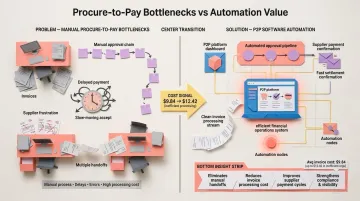
A UK finance team chasing a supplier invoice that doesn't match its purchase order, while the person who approved the spend is on holiday, is facing exactly the problem procure-to-pay software companies set out to solve. In the UK the process is often called purchase-to-pay, and for VAT-registered businesses it carries extra weight: supplier invoices underpin input VAT reclaims and the digital records required under Making Tax Digital, and large companies must publicly report how quickly they pay their suppliers.
Manual handoffs, missed approvals and late payments drain finance time, frustrate suppliers and create audit headaches. This guide explains how the procure-to-pay cycle works, how P2P differs from source-to-pay, the main types of software vendors, the UK-specific checks to make (VAT, payment reporting, public-sector rules and GBP/EUR suppliers), and what to look for when choosing a platform.
Key Takeaways
- P2P software automates the full cycle from purchase requisition to supplier payment, replacing manual processes with connected workflows
- Solutions range from standalone AP automation tools to full-suite platforms and ERP extensions — suited to different business sizes and maturity levels
- Core features: PO management, invoice matching, approval workflows, and accounting system integration
- Choosing the right fit comes down to transaction volume, workflow complexity, and how tightly you need to control spend visibility and approval flows
- UK buyers should check VAT invoice capture, a Making Tax Digital-compatible link to their accounting software, payment practices reporting data and support for GBP and EUR suppliers
- Source-to-pay suites add sourcing, tendering and contract management on top of P2P; many mid-market UK teams need strong purchase-to-pay controls first
What Is Procure-to-Pay Software?
Procure-to-pay (P2P), often called purchase-to-pay in the UK, is the end-to-end business process that begins when an employee identifies a need for goods or services and ends when the supplier is paid. The cycle covers requisition, approval, ordering, receiving, invoicing, and payment—the buyer's complete purchasing journey.
P2P differs from adjacent terms. Source-to-pay (S2P) includes upstream sourcing and contract negotiation before purchasing begins, while order-to-cash (O2C) is the mirror process from the seller's perspective. P2P focuses specifically on the buyer's downstream purchasing activities after supplier relationships are already established.
P2P software companies are businesses that build and sell platforms, tools, or modules designed to digitise and automate one or more steps within the procure-to-pay cycle. These range from niche invoice automation vendors to full-suite procurement platforms.
The market is substantial and growing. The global procure-to-pay software market was valued at US$8.02 billion in 2024 and is projected to reach US$14.07 billion by 2033, growing at a 6.8% CAGR. That expansion is largely driven by finance teams replacing manual approval chains and paper-based invoicing with systems that enforce process compliance automatically.
How the Procure-to-Pay Cycle Works
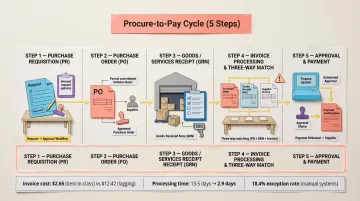
Understanding the P2P cycle reveals where automation delivers the most value. The process unfolds in five key stages:
Step 1 — Purchase Requisition (PR)
An employee or team identifies a need and submits an internal purchase request. This triggers an approval workflow to validate the spend before any supplier engagement occurs. The requisition typically includes item details, quantity, estimated cost, and business justification.
Step 2 — Purchase Order (PO)
Once the requisition is approved, a formal purchase order is generated and sent to the chosen supplier. The PO legally commits both parties to the agreed terms—quantity, price, delivery timeline, and payment conditions. This document becomes the foundation for subsequent verification steps.
Step 3 — Goods or Services Receipt
When the supplier delivers, the receiving team logs the goods receipt note (GRN) or service confirmation. This document captures what was actually received, including quantities, condition, and any discrepancies.
Step 4 — Invoice Processing and Three-Way Matching
The supplier submits an invoice, which the system then matches against the original PO and the GRN. This three-way match is where most manual P2P processes break down at scale. According to Ardent Partners' 2025 State of ePayables report, the industry average invoice exception rate sits at 18.4%, forcing AP staff to manually resolve discrepancies before payment.
Mismatches—whether due to pricing differences, quantity variances, or missing documentation—trigger exceptions that must be resolved before payment can proceed.
Step 5 — Approval and Payment
Matched invoices are routed through approval workflows and, once cleared, payment is issued to the supplier according to the agreed terms. P2P software tracks the full audit trail throughout, creating a timestamped record of every approval, exception, and transaction.
The cost difference between automated and manual processing is significant. According to the same Ardent Partners report, a global benchmark quoted in US dollars, Best-in-Class organisations process invoices at USD $2.65 each versus USD $12.42 for lagging organisations — a 79% cost reduction. Processing times compress from 13.5 days to just 2.9 days.
Types of Procure-to-Pay Software Companies
The procurement technology landscape is fragmented. Understanding the different categories helps you match your specific pain points to the right solution type.
Partial or Point Solutions
These companies automate a single stage in the cycle. AP automation tools, for example, focus exclusively on invoice capture, matching, and payment; others offer standalone PO management. Examples include Tipalti, Stampli, Bill.com, and Rossum.
Best for: Businesses with a specific bottleneck they need to fix without replacing their entire stack. If your primary pain is manual invoice data entry but upstream purchasing is already controlled, a point solution may suffice.
Full-Suite P2P Platforms
Dedicated end-to-end platforms cover every stage from requisition to payment in a single connected system, including supplier management. Leading vendors include Coupa, JAGGAER, Ivalua, Basware, and Medius.
Best for: Organisations with high transaction volumes who need complete process visibility and compliance controls. These platforms excel when you need strict upstream purchasing controls and downstream payment execution in one system.
ERP Extensions and Modules
P2P functionality offered as a module inside a broader ERP system, such as SAP Ariba, Oracle Fusion Cloud Procurement, or NetSuite Procurement.
The trade-off: Tight integration with existing financial data but often less flexibility and higher implementation cost. Customisation typically requires expensive professional services and lengthy deployment cycles.
Best for: Enterprises committed to a single-vendor ERP architecture who prioritise data consistency over workflow flexibility.
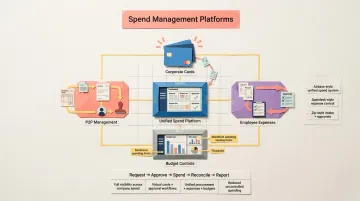
Spend Management Platforms
Broader platforms that bundle P2P with expense management, corporate cards, and budget controls. Examples include Airbase, Spendesk, and Zip.
Best for: Growth-stage companies that need visibility across all business spend, not just supplier purchasing, and want to control employee spend through virtual cards and intake workflows.
Custom-Built Procurement Systems
Some businesses with non-standard workflows, regulatory constraints, or unique operational models often find that off-the-shelf P2P tools force them to adapt their processes to the software, not the other way around.
Keel is built for exactly this situation. Its code-first platform gives operations teams full ownership of their procurement workflows, including:
- Custom approval chains and purchasing rules
- Supplier onboarding forms and performance tracking through custom KPIs, with multi-currency and multi-location support
- Requisition-to-PO flow, PO-based receipts (full, partial or over), three-way matching and budget tracking that reflect how they actually work
Teams can launch these systems in weeks, then evolve them as the business changes — without waiting on a vendor or re-implementing from scratch.
Best for: Companies that have outgrown generic tools but don't want to commit to a legacy ERP.
Key Features to Look for in P2P Software
Procurement and Approval Workflows
The core value of P2P software is its ability to enforce structured approval chains. Look for:
- Configurable multi-level approvals tied to spend thresholds, department, or supplier type
- Workflow routing that prevents maverick spending by ensuring all purchases flow through defined approval paths
- Audit trails that track who created and approved each purchase order
When evaluating vendors, test edge cases: what happens when an approver is out of office, or when a purchase spans multiple cost centres? The answers reveal how robust the workflow engine actually is.
Invoice Management and Matching
Modern P2P platforms use AI-native invoice capture rather than legacy OCR. AI and Machine Learning models achieve approximately 99% field-level accuracy with sub-3-second processing times, compared to 85-95% accuracy for template-based OCR.
Look for:
- Automated invoice capture through OCR or e-invoicing
- Three-way matching logic that automatically compares PO, GRN, and invoice
- Exception handling workflows that route mismatches to the right person for resolution
- Line-item extraction accuracy—header-level accuracy is standard, but accurate line-item capture enables true straight-through processing
Poor matching accuracy is one of the leading causes of late payments — which means supplier relationship damage and missed early-payment discounts.
Integrations and Reporting
P2P software only delivers full value when it connects to the systems finance teams already use—accounting software, ERPs, banking platforms.
Look for:
- Native integrations with common systems (Xero, Sage, QuickBooks, NetSuite, SAP, etc.)
- Open APIs for custom integrations
- Real-time spend dashboards that give finance leaders visibility without manual reporting
- Webhook support for event-driven integrations
A platform without strong integration support forces finance teams to maintain parallel systems and reconcile data manually. That overhead quickly erodes any efficiency gains from automation.
Benefits of Automating Your Procure-to-Pay Process
Cost and Error Reduction
Manual P2P processes are prone to duplicate payments, missed discounts, and fraud through invoice tampering, and the risk grows with every supplier, approver and currency you add.
Automation eliminates manual data entry, reduces exception rates from 18.4% to 11.1%, and enables straight-through processing for over half of all invoices.
Faster Cycle Times and Supplier Satisfaction
Automated matching and approval routing eliminates the bottlenecks that cause late payments. According to SAP Taulia research, 55% of suppliers reported being paid late during 2025, up from 51% the previous year. Payment delays now account for 37% of the total payment cycle worldwide.
Faster processing strengthens supplier relationships and can unlock early payment discounts. Where suppliers offer a discount for paying early, fast matching and approvals are what let you actually take it, making AP one of the few operational functions that directly generates measurable returns.
Compliance, Audit Trails, and Spend Visibility
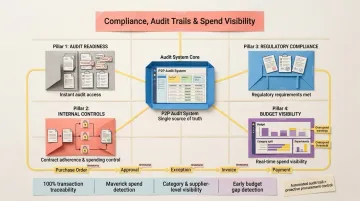
P2P software creates a complete, timestamped record of every transaction, approval, and exception. This matters across several areas:
- Audit readiness: Instant access to complete procurement documentation
- Internal controls: Ensuring spending stays within negotiated contract terms
- Regulatory compliance: Meeting requirements in regulated industries
- Budget management: Real-time visibility into spend by category, department, or supplier
When every purchase order, approval, and exception is logged automatically, procurement teams can spot maverick spending, renegotiate supplier contracts based on actual usage, and close budget gaps before they compound.
How to Choose the Right P2P Software for Your Business
Assess Your Transaction Volume and Process Complexity
A business processing hundreds of invoices monthly with multi-entity structures and complex approval hierarchies has very different needs than a team managing a handful of supplier relationships.
Questions to ask:
- How many purchase orders and invoices do we process monthly?
- How many approval levels do we need?
- Do we operate across multiple locations, currencies, or legal entities?
- Do we have unique supplier requirements or regulatory constraints?
Map your actual workflow before evaluating tools. Don't assume your process should conform to the software—find software that can conform to your process.
Evaluate Integration Requirements First
The most capable P2P platform fails if it creates a data silo. List every system the tool must connect with:
- ERP or accounting software (Xero, Sage, NetSuite, SAP)
- Banking platforms for payment execution
- Procurement catalogues or supplier portals
- Inventory management systems
- Expense management tools
Treat integration depth as a must-have, not an afterthought. Ask vendors for specific integration details, not just "we integrate with Xero." Understand whether it's a native integration, API-based, or requires middleware.
Consider How Much Flexibility and Ownership You Need
Fast-moving operations teams often hit the ceiling of standard P2P tools as their workflows evolve. Rigid configurations and slow vendor release cycles make it harder to adapt when your processes change.
Signs you need more flexibility:
- Your approval workflows don't fit standard templates
- You need to iterate on processes quarterly, not annually
- You operate in a regulated industry with unique compliance requirements
- Your supplier relationships include non-standard terms or performance tracking
- You're maintaining parallel spreadsheets because the platform doesn't support your actual process
For teams that need procurement systems tailored to how they actually operate, Keel offers a code-first alternative worth evaluating. Rather than adapting your workflows to a pre-built mould, Keel lets teams define custom data models, approval logic, and supplier management rules from the ground up. Changes deploy in weeks, not on a vendor's roadmap. Keel is built by Planko Ltd, a company registered in the United Kingdom, is registered with the ICO (ZB524558), and lets you choose where your procurement data is hosted, including the UK.
Frequently Asked Questions
What is a procure-to-pay software?
P2P software automates the full buying cycle from purchase requisition through to supplier payment, replacing manual handoffs with connected, auditable digital workflows. It covers requisition, PO creation, receiving, invoice matching, approval routing, and payment execution.
What comes first, PR or PO?
A Purchase Requisition (PR) always comes first. It is the internal request for approval to buy. A Purchase Order (PO) is only generated after that requisition is approved, becoming the formal commitment sent to the supplier.
What software is best for PO tracking?
The best PO tracking software depends on your business size and tech stack. Full P2P platforms such as Coupa, Procurify or JAGGAER include robust tracking within broader workflows, while standalone tools or ERP modules often suit smaller teams. Prioritise real-time status visibility, goods-in against each purchase order and a clean integration with your accounting software, such as Xero or Sage for many UK businesses.
What is the difference between a PO and a RFP?
A Request for Proposal (RFP) is issued before a supplier is selected—it invites vendors to submit bids or proposals for a defined scope of work. A Purchase Order is issued after a supplier has been chosen and represents the formal, binding order to proceed.
What is the difference between procure-to-pay and source-to-pay?
Source-to-pay includes the full upstream sourcing process—identifying suppliers, running RFPs, negotiating contracts—before the purchase begins. Procure-to-pay starts after a supplier relationship and contract are already in place, covering the actual purchasing and payment execution.
Can small or mid-sized businesses benefit from P2P software?
Yes, UK SMEs and scaling mid-market businesses benefit significantly from automating approvals and invoice matching as transaction volumes grow. Automation cuts re-keying of supplier invoices, keeps VAT data consistent for Making Tax Digital returns and speeds up supplier payments. Many modern platforms offer modular or tiered pricing, making automation accessible well below enterprise budgets.
Is purchase-to-pay the same as procure-to-pay?
Yes, purchase-to-pay and procure-to-pay describe the same process, and both are shortened to P2P. Purchase-to-pay is the term more often used by UK finance teams and some vendors, while procure-to-pay is more common in US content. Both cover the steps from purchase requisition and purchase order through goods receipt, invoice matching and supplier payment. Source-to-pay is different: it adds supplier sourcing, tendering and contract management before purchasing starts.
Who are the main source-to-pay software vendors?
The main source-to-pay software vendors include SAP Ariba, Coupa, Ivalua, Oracle Fusion Cloud Procurement, JAGGAER, GEP SMART and Zycus, with Basware, Proactis and SynerTrade also appearing in industry top-10 lists. These suites cover sourcing, contract management, purchasing, invoicing and payment. Before shortlisting, read verified user reviews on Gartner Peer Insights and ask each vendor about UK customers, VAT handling and implementation costs, which can be significant for enterprise projects.
What should UK businesses check in P2P software?
UK businesses should check that P2P software captures VAT correctly and connects to Making Tax Digital-compatible accounting software such as Xero or Sage. Also confirm it records the dates needed for payment practices reporting if you are a large company, supports GBP and EUR suppliers, and lets you choose where your data is hosted to meet UK GDPR obligations. If you sell to or buy for the public sector, look for a full audit trail of orders and invoices.
Is P2P software suitable for enterprises with multiple entities and currencies?
Yes, enterprise P2P and source-to-pay suites are built for multiple legal entities, cost centres and currencies, including GBP, EUR and USD. Expect features such as entity-specific approval rules, consolidated spend reporting, multi-currency purchase orders and supplier networks. The trade-off is implementation effort: industry commentary suggests enterprise implementation fees can run from 50% to 150% of the first-year subscription, so agree a fixed scope before you sign.
How is machine learning used in procure-to-pay software?
Machine learning in procure-to-pay software is mainly used to read supplier invoices and match them to purchase orders and goods receipts. AI-based capture extracts header and line-item data more accurately than template-based OCR, which reduces exceptions and manual keying. Some platforms also use it to flag duplicate invoices, suggest general ledger codes and highlight unusual spend. For UK teams, check that extracted VAT amounts and supplier VAT numbers are captured reliably.