
Introduction
UK businesses that store and ship goods live or die by warehouse management efficiency. When a picker in a UK warehouse grabs the wrong product, the ripple effect is expensive: the average mispick costs between £18 and £37 in direct logistics costs alone, factoring in original shipping, return shipping, replacement shipping, and labour. For a high-volume operation shipping 6,000 orders daily, even a seemingly acceptable 1% error rate results in nearly £5,000 in lost revenue every day.
Beyond direct costs, poor warehouse management severely damages customer retention. Research shows that 65% of consumers abandon a retailer after 2-3 late deliveries, and 81% churn after receiving 2-3 incorrect orders. Those numbers make warehouse performance a retention issue, not just an operations one, for UK operations teams as much as anywhere else.
This guide covers everything UK operations teams need to understand about modern warehouse management: the definition and six core processes, how WMS software works, the four types of WMS, and proven best practices to optimise every stage of your warehouse operation.
Key Takeaways
- Warehouse management coordinates all daily operations: receiving, storage, picking, packing, and shipping
- A Warehouse Management System (WMS) automates these processes, providing real-time inventory visibility and operational guidance
- WMS comes in four main types: standalone, ERP-integrated, cloud-based, and 3PL
- Best practices include strategic slotting, cycle counting, demand-based picking, and tracking KPIs like picking accuracy
- Choosing the right WMS means prioritising flexibility, integrations, and workflow fit over raw feature count
- Poor picking accuracy carries a direct UK cost: the average mispick runs £18-£37 in logistics costs alone, and 65% of consumers abandon a retailer after 2-3 late deliveries
- Keel is a UK-registered, ICO-registered platform, giving UK operations teams a locally accountable, code-first alternative to configuring workflows around an offshore vendor's roadmap
What Is Warehouse Management?
Warehouse management is the set of principles, processes, and systems used to run the daily operations of a warehouse—from organising storage space and scheduling labour to fulfilling orders and coordinating with suppliers and carriers. It's broader than simply storing goods; it encompasses the entire operational ecosystem that keeps inventory moving efficiently from receiving dock to customer doorstep.
Warehouse Management vs. Inventory Management
These terms are often confused, but they serve distinct functions:
- Inventory management focuses on tracking stock levels and reordering across the entire supply chain
- Warehouse management governs everything that physically happens inside the warehouse
- Stock management is a further subset focused specifically on finished goods
In short: inventory management tells you what you have and when to reorder; warehouse management controls where it lives, how fast you can locate it, and how efficiently it ships.
Why Warehouse Management Matters
Warehouse management is largely invisible to customers—until something goes wrong. A well-run warehouse enables on-time delivery, correct order accuracy, and lower costs. A poorly run one leads to delays, returns, and lost loyalty. That gap between the two typically comes down to process discipline and the systems supporting it.
The 6 Core Processes of Warehouse Management
Each of these six processes connects directly to the next. Weaknesses at any stage ripple forward — slow receiving creates put-away backlogs, poor slotting slows picking, and inaccurate picking creates packing errors. Here's how each one works.
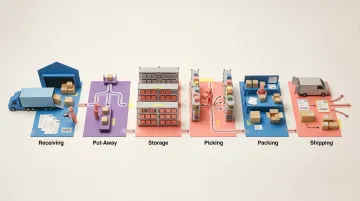
Receiving
Receiving is the entry point for all goods. This process involves checking inbound shipments against purchase orders for quantity, condition, and accuracy. Errors caught at receiving prevent downstream problems that multiply in cost and complexity.
Manual receiving processes are highly susceptible to human error. Transitioning to barcode scanning or RFID can reduce receiving time for 500 cartons from 2-3 hours with two workers to just 15-30 minutes with one worker.
Put-Away
Put-away moves goods from the receiving dock to designated storage locations. A WMS directs workers to optimal slots based on:
- Product velocity (how frequently items are picked)
- Physical dimensions and weight
- Product category or handling requirements
Strategic put-away reduces travel time and improves space utilisation, directly impacting downstream picking efficiency.
Storage
Storage strategy determines retrieval efficiency. Effective storage involves:
- Slotting fast-moving SKUs near pick stations and at accessible heights
- Separating visually similar products to reduce mis-picks
- Using environmental controls (temperature, humidity) for perishable or sensitive goods
- Revisiting slotting periodically as demand patterns shift
Storage isn't static — it requires continuous optimisation as your product mix and order profiles evolve.
Picking
Picking — collecting items to fulfil customer orders — has the highest impact on fulfilment speed and accuracy. Travel time accounts for 50% or more of total picking time in most traditional warehouses, making route and strategy decisions critical.
Common picking strategies include:
- Batch picking: Multiple orders picked simultaneously, ideal for high volumes of single-SKU orders
- Zone picking: Warehouse divided into zones with dedicated pickers, suited for large multi-SKU orders
- Wave picking: Orders grouped by shipping schedule or carrier, optimising dock utilisation
The right strategy depends on your order volume, SKU variety, and facility layout.
Packing
Packing serves two functions: verification and protection. Workers check picked items against the order, then pack them securely with the correct documentation and labels.
Smart packing software can recommend optimal box sizes to reduce material waste and shipping costs. For operations shipping thousands of orders daily, these marginal gains compound into substantial savings.
Shipping
The final step groups packed orders by carrier and route, generates shipping documentation, and loads vehicles. WMS integration with transportation management systems (TMS) ensures tracking data updates automatically and customers receive accurate delivery estimates.
What Is a Warehouse Management System (WMS)?
A Warehouse Management System (WMS) is software designed to digitise, automate, and optimise all warehouse management processes—from the moment goods arrive to the moment they leave. The WMS market is experiencing rapid expansion, projected to grow from $2.7 billion in 2025 to $12.8 billion by 2033, representing a 21.9% compound annual growth rate.
Core Capabilities of a WMS
Modern WMS platforms provide:
- Location and quantity visibility down to the bin level, updated in real time
- Step-by-step task assignment and guided workflows for warehouse staff
- Connections with ERP, TMS, and accounting systems
- Daily operational planning based on order patterns
- Performance dashboards and analytics for managers
Three Levels of WMS Complexity
Basic WMS:
- Inventory tracking and location control
- Simple receiving and shipping workflows
- Basic reporting
Advanced WMS:
- Capacity analysis and space optimisation
- Labour tracking and efficiency metrics
- Advanced picking strategies
- Multi-location management
Intelligent WMS:
- External data exchange and API integrations
- IoT and automation integration
- Machine learning-based optimisation
- Predictive analytics
Match your operational needs to the right tier—overbuying features you won't use wastes budget and complicates implementation.

WMS vs. ERP Warehouse Modules
ERP warehouse modules prioritise financial metrics and tend to lack operational depth. They're designed for basic inventory management, not real-time warehouse execution. Standalone WMS solutions offer richer operational flexibility but require integration work.
A known limitation of legacy WMS and ERP systems is rigidity. Standard WMS software often forces compromises between how a warehouse wants to work and how the system allows it to work. Older systems lack native cloud support, have hard-coded workflows, and rely on manual upgrades—making expansion to new warehouses or new workflows time-consuming and expensive.
The Modern Alternative: Code-First Operations Platforms
That rigidity is pushing operations teams toward a different model. Platforms like Keel are built for teams that need the flexibility of a custom WMS without months of development work.
Keel is a code-first platform that lets teams build, own, and iterate on warehouse management workflows tailored to their exact processes, connecting directly to their existing tools and systems. You configure the system around your warehouse layout, naming conventions, and actual workflows. No rigid templates, no vendor lock-in, and no waiting on a development backlog every time your operations change.
Four Types of Warehouse Management Systems
Not all WMS products are built the same. The right fit depends on your operational complexity, existing tech stack, and how much customisation you actually need.
Standalone WMS
Purpose-built software dedicated entirely to warehouse operations, offering the deepest feature set and configurability. These systems excel at complex warehouse execution — pick-and-pack workflows, multi-zone slotting, wave management — but require meaningful integration effort with ERP, OMS, and TMS systems. The right call when warehouse complexity genuinely justifies a specialised solution.
ERP-Integrated WMS
A warehouse module embedded within a broader ERP platform, with tight financial and operational data alignment built in. The downside: these modules rarely match the operational depth of a dedicated WMS. They work well when financial reporting and warehouse data must stay tightly coupled and warehouse operations are relatively straightforward.
Cloud-Based WMS
Delivered as SaaS, accessible from any device, with lower upfront costs and faster deployment than on-premise alternatives. Cloud-based platforms now account for 55.21% of WMS market revenue and are projected to grow at 19.12% annually through 2031. The trade-off is customisation depth — most off-the-shelf cloud products offer limited configurability in exchange for ease of deployment.
3PL WMS
Designed specifically for third-party logistics providers running warehouse operations across multiple clients. Core features include multi-client billing, client portals, and shared inventory management. Powerful if you're a 3PL — unnecessarily complex if you're managing a single-client operation.
Warehouse Management Best Practices
Optimise Warehouse Layout and Slotting
Slotting assigns products to specific storage locations based on pick frequency, size, and order profiles. This directly reduces travel time for pickers and increases throughput.
Strategic slotting principles:
- Store A-class (high-velocity) SKUs near packing stations and at accessible heights
- Position heavy or bulky items at ground level to reduce injury risk
- Separate visually similar products to prevent mis-picks
- Revisit slotting quarterly as demand patterns shift
A WMS can automate slotting recommendations based on historical pick data, eliminating guesswork.
Implement Cycle Counting Over Annual Stocktakes
Cycle counting is the practice of continuously auditing small portions of inventory on a rolling schedule, rather than shutting down operations for a full annual count.
Benefits of cycle counting:
- Catches discrepancies faster, maintaining ongoing accuracy
- Reduces operational disruption—no warehouse shutdown required
- Prevents errors from accumulating for an entire year
- Achieves inventory count accuracy of ≥99.5% by location for top-performing operations
Approximately 65% of retail inventory records are inaccurate at the point of annual physical audit. Cycle counting addresses this by validating system accuracy continuously without halting operations.
Use Demand-Matched Picking Strategies
Matching your picking strategy to order profile prevents wasted movement:
- Batch picking: High volumes of single-SKU orders
- Zone picking: Large multi-SKU orders with multiple pickers
- Wave picking: Orders grouped by shipping schedule or carrier
- FIFO/FEFO rules: Time-sensitive or perishable stock
A WMS can enforce these rules automatically, routing pickers through optimal paths and preventing expired stock from shipping.
Leverage Real-Time Data and Automation
Barcode scanning, RFID tagging, and WMS-driven task management eliminate manual data entry errors and create a real-time audit trail for every item movement.
Error reduction through technology:
- Barcode scanning reduces picking errors by nearly 70%—from around 30 per 1,000 picks to under 10
- RFID technology achieves 99.9% order accuracy, compared to a 69% error rate with traditional manual processes
- Barcode systems typically provide full ROI within 4-12 months through 20-40% labour cost reduction

This data also powers continuous improvement—identifying bottlenecks, optimising workflows, and validating process changes.
Build Workflows You Can Actually Iterate On
A common pain point: once a WMS is configured, changing workflows requires expensive vendor involvement or long development cycles. Best-practice operations teams invest in tooling they can evolve rapidly.
Whether through configurable WMS software or platforms like Keel that let operators own and modify their workflows without waiting on external vendors, the ability to iterate quickly matters. Your warehouse operations will change as your business grows. The systems running them need to keep pace — not lock you into yesterday's processes.
What iterability looks like in practice:
- Reconfigure pick paths or workflows without raising a vendor ticket
- Test process changes in staging before rolling out to the floor
- Own your data model so integrations don't break when you scale
Key KPIs for Warehouse Management
Track these five critical metrics to measure and improve warehouse performance:
1. Picking Accuracy The percentage of orders fulfilled without error. Best-in-class operations hit ≥99.68% accuracy. Catching mistakes before shipment prevents costly returns and customer churn.
2. Order Lead Time The average time from order placement to customer delivery, covering both warehouse processing and transit. Shorter lead times translate directly into higher satisfaction and repeat purchase rates.
3. Receiving Efficiency Measured as dock-to-stock cycle time — best-in-class operations clear goods in under 3.5 hours. Faster receiving keeps docks clear and gets stock available sooner.
4. Inventory Turnover How often stock is sold and replenished within a given period. Benchmarks vary by sector: fashion runs 6.0–12.0 turns annually, electronics 4.5–8.0 turns, and home goods 2.5–5.0 turns. Higher turnover reduces carrying costs and the risk of obsolete stock.
5. Rate of Product Return The percentage of shipped orders returned, broken down by reason — wrong item, damaged goods, and so on. Separating warehouse-attributable returns from customer preference returns is what matters here; it isolates genuine operational failures from normal buying behaviour.
Tracking these numbers in isolation achieves little. The value comes from pairing each metric with a clear target, acting on what the data shows, and measuring whether performance actually shifts. A WMS with a well-designed dashboard makes this cycle visible to both warehouse managers and the staff executing daily operations.
Frequently Asked Questions
What does warehouse management do?
Warehouse management oversees all daily operations inside a warehouse—receiving goods, organising storage, directing picking and packing, and shipping orders—with the goal of fulfilling customer orders quickly, accurately, and cost-effectively.
What are the four types of warehouse management systems?
The four types are: standalone WMS (dedicated, feature-rich), ERP-integrated WMS (embedded in broader business software), cloud-based WMS (SaaS, accessible anywhere), and 3PL WMS (built for third-party logistics providers managing multiple clients).
What are the 7S rules in warehouse management?
The 7S framework builds on the lean 5S methodology by adding two extra steps: Sort, Set in Order, Shine, Standardise, Sustain (the original 5S), plus Safety (6S) and Spirit (7S). It provides a practical method for organising a clean, efficient, and safe warehouse, though 6S and 7S are practitioner extensions rather than ISO-standardised frameworks.
What is the difference between warehouse management and inventory management?
Warehouse management covers all physical operations inside the warehouse (receiving, storage, picking, packing, shipping), while inventory management tracks stock levels, reorder points, and product movement across the entire supply chain.
What are the most important KPIs in warehouse management?
The core metrics are picking accuracy, order lead time, inventory turnover, receiving efficiency, and rate of product return. A WMS makes it practical to track and act on these in real time, enabling continuous operational improvement.
How do I know when my business needs a dedicated WMS?
Common triggers include: inventory errors are increasing, spreadsheets or basic software can't keep up with order volume, picking mistakes are rising, or you're scaling into multi-location operations. At that point, a dedicated WMS—or a custom operations platform—becomes essential to maintain accuracy and efficiency.
Does UK GDPR affect how warehouse management systems handle data?
Yes. Any UK business running a WMS that stores personal data - for example, courier or customer contact details attached to shipments - falls under UK GDPR and the Data Protection Act 2018, regulated by the ICO. This affects how long shipping data is retained, who can access it, and where it's hosted, so it's worth checking a WMS vendor's UK data-hosting options and audit trail capabilities before implementation, not after.
Is VAT relevant to warehouse management software?
Indirectly. Most warehouse management systems don't calculate VAT themselves, but they typically need to connect to the accounting or ERP system that does, so that goods movements, cost of goods sold, and stock valuations stay consistent with what's reported for VAT purposes. UK businesses that are VAT-registered (mandatory above the £90,000 threshold, in force from 1 April 2024) should confirm a WMS or code-first alternative can sync cleanly with their accounting tool rather than requiring manual reconciliation.
Do UK warehouses need a locally hosted WMS?
Not necessarily, but many UK operations teams prefer the option. Multi-region data residency is increasingly common among modern WMS and code-first platforms, letting you choose where your warehouse data is hosted, including in the UK, rather than being locked into wherever a vendor's default region happens to be. If data residency matters for your compliance requirements, confirm this before selecting a platform.