Introduction
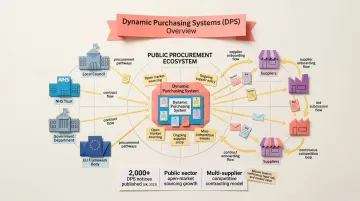
A dynamic purchasing system (DPS) is an electronic, open procurement tool that UK public sector buyers use to buy commonly used goods, works and services from pre-qualified suppliers who can join at any time. Councils, NHS trusts, housing providers and central government departments use DPS agreements for everything from building repair and maintenance to IT, staffing and transport. According to the Government Commercial Agency (GCA), a DPS can "cut procurement times to as little as 10 days".
This guide is written for UK public sector buyers and the suppliers, including SMEs, who bid into them. It explains what a DPS is, how a DPS contract is awarded, how a DPS compares with a framework, how to join one through Find a Tender, Contracts Finder or Public Contracts Scotland, and how dynamic markets under the Procurement Act 2023 are replacing new DPSs.
Many buyers still use a DPS for the wrong categories, and suppliers waste bid effort on poorly scoped further competitions.
Key Takeaways
- A DPS is a fully electronic, permanently open procurement arrangement—eligible suppliers can join at any point during its lifetime
- It operates in two phases: supplier qualification (rolling, pass/fail admission) and mini-competitions (further competitions for specific contracts)
- Unlike a framework, a DPS never closes to new suppliers, keeping it competitive and market-responsive
- Best suited for high-volume, repeatable categories with competitive, evolving supply markets (IT services, staffing, transport, facilities)
- Running one effectively demands clear eligibility criteria, digital infrastructure, and active supplier engagement
- In the UK, the Procurement Act 2023 introduced dynamic markets as the replacement for new DPSs from February 2025; DPSs set up before then can stay open under PCR 2015
- UK suppliers find DPS opportunities on Find a Tender, Contracts Finder, Public Contracts Scotland and the Cabinet Office list of live agreements, and can apply at any time
What Is a Dynamic Purchasing System?
A Dynamic Purchasing System is a fully electronic procurement arrangement used by contracting authorities for purchasing commonly available goods, works, or services. Under UK regulations (PCR 2015, evolving under the Procurement Act 2023), it must remain open to new applicants throughout its entire duration—this is its defining legal characteristic.
Why DPS Exists
Traditional procurement tools like framework agreements freeze the supplier list at setup, locking out late entrants, newly formed businesses, and innovative providers for years. DPS was designed specifically to solve this by keeping procurement permanently open and maintaining a live, competitive supplier pool.
What a DPS is NOT:
- Not a framework (no closed supplier list)
- Not a direct award mechanism (every purchase requires a further competition)
- Not a product catalogue
- Not a standing arrangement from which buyers can simply call off work
Structure of Lots
A single DPS can be divided into lots, each representing a separate category of goods or services. Each lot functions as its own open supplier pool with its own qualification criteria. Buyers issue mini-competitions within the relevant lot, not across the whole DPS. This granular structure prevents supplier fatigue and keeps competitions focused.
UK Regulatory Evolution
That lot-based structure carries forward into the new regulatory landscape, though the terminology is changing. The Procurement Act 2023 introduces a successor concept called the "Dynamic Market," replacing the DPS under the old PCR 2015 regime. The underlying logic is similar, but procedural details are shifting — anyone setting up or responding to procurements post-February 2025, when the Act came into force, should account for this.
Legacy DPS arrangements established under PCR 2015 continue under those rules until their end date. Many central government DPSs on the Cabinet Office list end on 23/02/29, but end dates vary, so check each agreement (see 'DPS and Dynamic Markets Under the Procurement Act 2023' below).
How Does a DPS Work?
A DPS operates as a two-phase, continuously running process. Phase one governs who can enter the supplier pool; phase two governs how contracts are awarded from that pool. Both phases run concurrently once the DPS is live.
Phase 1 — Establishment and Supplier Qualification
The contracting authority publishes a contract notice advertising the DPS, defines the scope and any lots, and sets out selection criteria (minimum standards, financial thresholds, technical capability). This is done once at setup—but unlike a framework, the DPS does not close after this initial notice.
Suppliers apply by submitting a Selection Questionnaire or equivalent documentation at any point during the DPS lifetime. If they meet the criteria—assessed on a pass/fail basis, not scored—they must be admitted.
Two compliance points shape how admission runs in practice:
- Admission timelines: PCR 2015 required a decision within 10 working days; the Procurement Act 2023 relaxes this to a "reasonable period." Buyers should set clear internal SLAs regardless, so suppliers can plan participation around upcoming competitions.
- Electronic-only process: Admission must be fully electronic. Manual onboarding or paper-based checks are non-compliant, and slow pipelines create both legal risk and supplier dissatisfaction.
Phase 2 — Mini-Competitions (Further Competitions)
When a buyer needs to make a purchase, they issue a mini-tender to all suppliers admitted to the relevant DPS lot. All admitted suppliers must be invited to compete—cherry-picking or limiting invitations without justification is non-compliant.
What the mini-tender contains:
- Specification
- Evaluation criteria
- Deadline
- Contract terms
Suppliers submit bids; the buyer evaluates them against published award criteria (Most Advantageous Tender under PA23—price, quality, social value weighting) and awards the contract to the winning bidder. Each mini-competition is a standalone exercise. There are no standing orders or guaranteed work for any supplier.
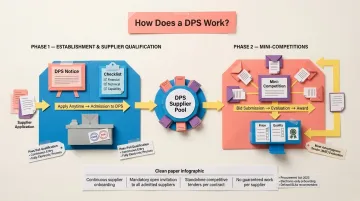
The quality of mini-competition design determines whether the DPS delivers value. Poorly scoped specifications attract poor bids—well-structured award criteria produce competitive, comparable responses that hold up to scrutiny.
Ongoing Management and Compliance
Running a DPS is not a set-and-forget exercise. Ongoing obligations include:
- Periodically re-advertising the DPS (via a PIN or equivalent notice) so new suppliers know it exists
- Removing suppliers for non-compliance, insolvency, or failure to maintain qualification standards
- Maintaining a full audit trail covering admission decisions, mini-tender documentation, bid evaluations, and award decisions
On standstill periods, the rules are worth knowing:
| Scenario | Standstill Requirement |
|---|---|
| PCR 2015 — DPS call-off contracts | Exempt from mandatory standstill |
| PA23 — DPS call-off contracts | Exempt from mandatory standstill |
| High-value call-offs (voluntary best practice) | Minimum 8 working days recommended |
The exemption exists, but buyers running high-value call-offs should consider applying a voluntary standstill period to reduce legal exposure.
DPS vs. Framework Agreements: Key Differences
A framework agreement is a closed list of pre-approved suppliers, set up through a full procurement process with agreed terms — once established, no new suppliers can join. Typical duration is up to 4 years. Buyers call off work either directly or via mini-competition from that fixed list.
The table below shows how the two tools compare across six key dimensions.
| Feature | Framework Agreement | Dynamic Purchasing System |
|---------|---------------------|---------------------------|
| Supplier Access | Closed after setup | Open throughout |
| Entry Timing | Initial window only | Any time |
| Duration | Usually a maximum of 4 years | No fixed length; set by the DPS owner (GCA DPSs run from 4 to 10+ years) |
| Contract Award Method | Direct call-off or mini-competition | Always via further competition |
| Best Suited For | Stable, well-understood categories | Evolving/competitive markets |
| SME Friendliness | Lower | High |
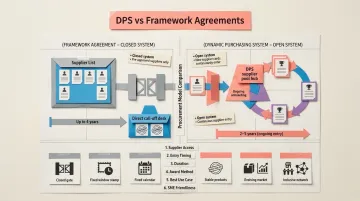
Practical decision rule: Use a framework when the supply market is stable, the number of qualified suppliers is manageable, and close supplier relationships are valuable. Use a DPS when the market moves fast, innovation matters, supplier turnover is high, or maximising competition and SME participation is a strategic goal.
That said, the two tools are not interchangeable.
Common misconception: A DPS is not simply a "more flexible framework." The legal obligations differ, the management burden is higher (rolling admissions, mandatory further competition), and applying the wrong tool to the wrong category creates inefficiency rather than solving it.
Where a DPS Works Best
DPS performs best for goods or services that are commonly available, purchased repeatedly, and sourced from a competitive market with multiple potential suppliers.
Common category examples:
- IT and digital services
- Temporary and contingent staffing
- Cleaning and facilities management
- Transport and logistics
- Catering and printing
- Cyber security
These are categories where the supplier market evolves quickly and locking in providers for years is a liability.
For national or regional procurement bodies managing geographically dispersed demand, DPS allows location-based filtering within lots — so local or specialist suppliers can compete for the contracts relevant to them. This gives smaller and regional providers a real route in, rather than losing out to larger incumbents on traditional frameworks.
Where DPS Should Not Be Used
DPS is not the right tool for every situation. Avoid it when:
- Direct award is required — DPS mandates further competition, so it cannot be used for single-supplier awards
- The project is highly bespoke or complex — one-off work benefits from an open or restricted procedure that allows greater control over specification
- You need a small, managed supplier group — where deep familiarity with a handful of providers matters more than market openness, a framework or preferred supplier arrangement is more appropriate
What It Takes to Run a DPS Successfully
Digital Infrastructure Is Non-Negotiable
A DPS must be fully electronic at every stage—supplier registration, document submission, admission decisions, mini-tender dispatch, bid receipt, and award notification. This means buyers need a capable e-procurement platform before launching a DPS. Manual workarounds are both non-compliant and operationally unscalable when managing dozens of suppliers across multiple lots.
For operations teams building or managing procurement workflows in-house, this is often the point where off-the-shelf tools show their limitations. Rigid legacy systems can't adapt to the rolling, configurable workflows a DPS demands. Platforms like Keel, which let teams build and own their operational systems, give procurement teams the flexibility to configure supplier onboarding forms and processes, approval workflows, user roles and permissions, and a complete audit trail alongside their e-tendering portal, without being forced into a fixed software mould.
Clear, Proportionate, and Legally Defensible Qualification Criteria
The selection criteria used to admit suppliers must be directly related to the subject matter of the DPS, non-discriminatory, and consistently applied. Overly restrictive criteria exclude capable suppliers and reduce competition; vague criteria create ambiguity and invite legal challenge.
Cabinet Office guidance sets clear boundaries on what buyers can require:
- No audited annual accounts from suppliers not legally obligated to produce them — a protection designed for SMEs
- No insurance certificates demanded before a contract is actually awarded
- No criteria unrelated to the subject matter of the DPS
Active Supplier Engagement and Market Communication
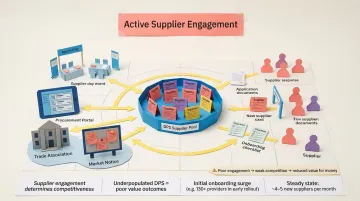
A DPS is only as effective as the supplier pool it attracts. Buyers must actively publicise the DPS—through supplier days, procurement portals, trade associations, and regular market notices—to ensure eligible suppliers know it exists and understand how to apply.
Poor supplier engagement is the most common reason DPS arrangements underperform. An underpopulated DPS produces uncompetitive mini-tenders and poor value for money. Onboarding tends to be busiest at launch, so plan admission capacity for the first months. Done well, engagement pays off: GCA says its DPSs, by matching public sector buyers with local suppliers, "help small and medium sized enterprises take part in public procurement" (https://www.gca.gov.uk/news/what-is-a-dynamic-purchasing-system).
Frequently Asked Questions
How to get on a DPS?
Apply to the DPS through its contract notice on Find a Tender, Contracts Finder or Public Contracts Scotland, or via the Cabinet Office list of live agreements. Choose the lots you can deliver, complete the selection questionnaire and wait for the pass/fail admission decision. Because a DPS stays open, UK suppliers can apply at any point during its life. See 'How to Join a DPS as a UK Supplier' above for the full steps.
What is the difference between a DPS and a framework?
The key difference is access: a framework closes its supplier list after initial setup, while a DPS remains permanently open to new applicants. Both use mini-competitions for awarding contracts, but only a DPS guarantees that new or late-entering suppliers can compete throughout the arrangement's life.
What is a DPS model?
The DPS model refers to this two-phase procurement structure: an open qualification phase where suppliers join a pre-approved pool, followed by a competitive tender phase where specific contracts are awarded from that pool. It is a regulated model defined under public procurement law, not a proprietary concept.
How long does a DPS last?
A DPS has no fixed length. The organisation that sets it up decides the maximum duration and states it in the tender documents. GCA says some of its DPSs run for a maximum of 4 years, while others last 10 years or more; frameworks usually last a maximum of 4 years. Legacy DPSs under the Public Contracts Regulations 2015 also have their own end dates, so check the specific agreement.
Can SMEs join a Dynamic Purchasing System?
DPS arrangements are specifically designed to be SME-friendly. Because the system stays open throughout its lifetime, smaller businesses can apply whenever they're ready, not just at launch. Qualification criteria must also be proportionate, preventing large-company bias and making DPS one of the more accessible public procurement routes available.
Is a DPS the same as a Dynamic Market under the Procurement Act 2023?
No. The Procurement Act 2023 introduced dynamic markets as the replacement for DPSs when it took effect in February 2025. Both keep an open, rolling supplier pool, but dynamic markets follow the new Act's procedures. DPSs established before February 2025 can remain open and continue under the Public Contracts Regulations 2015, so which regime applies depends on when the agreement was set up.
What is a DPS contract?
A DPS contract is the call-off contract a buyer awards to one supplier after running a further competition among the suppliers admitted to the relevant DPS lot. Joining the DPS itself is not a contract for work: it only makes you eligible to bid. Every DPS contract must go out to competition, and GCA confirms direct award is not possible under a DPS.
Who can use a dynamic purchasing system in the UK?
UK public sector bodies, and some third sector organisations, can buy through a DPS if the agreement's owner allows them to. For GCA agreements, you must be authorised as a public or third sector buyer to register for the DPS Marketplace. Regional DPSs, such as Northern Procurement Agency's, are open to local authorities, social landlords and other public sector bodies.
Where can I find DPS opportunities in the UK?
Search Find a Tender and Contracts Finder for DPS contract notices, and Public Contracts Scotland if you supply Scottish public bodies. The Cabinet Office Supplier Registration Service also lists live central government DPS agreements with their IDs and end dates. Regional buyers and intermediaries, such as Northern Procurement Agency and Constructionline, publish their own DPS schemes and portals.
Has the dynamic purchasing system been replaced?
Yes, for new agreements: the Procurement Act 2023 introduced dynamic markets as the replacement for DPSs when it took effect in February 2025. Existing DPSs set up before then can stay open and continue to be governed by the Public Contracts Regulations 2015. Check each agreement's end date on the Cabinet Office or GCA agreements pages.
How quickly can a buyer award a contract through a DPS?
A DPS is one of the faster public procurement routes because suppliers are already pre-qualified. GCA says DPSs can cut procurement times to as little as 10 days. In Scotland, the Scottish Government's guidance sets a minimum of 10 days for returning tenders, and buyers should allow longer for complex requirements.